
Prestigious items that will take your breath away with their precise and high-quality craftsmanship. Above all, these are timeless pieces, milestones of eras, markers of past masters and renowned designers. Let them captivate and inspire you, even in your own abode.

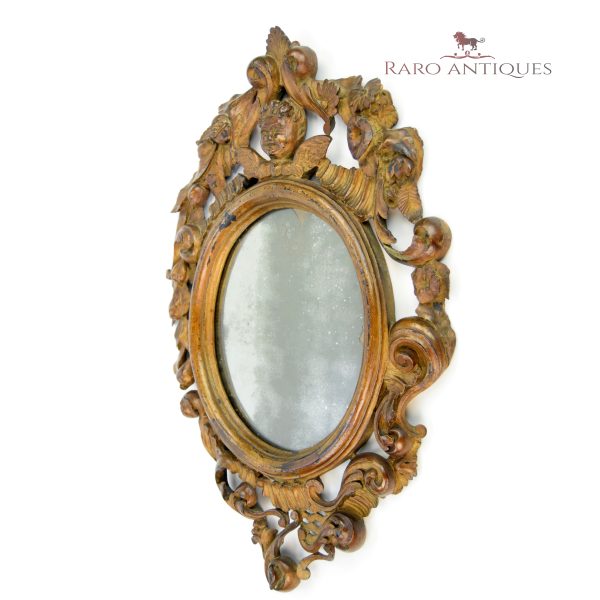
ANTIQUE MIRROR
A mirror made in the second half of the 18th century.
An exceptional wall mirror featuring its original glass. It is crafted from carved wood, richly decorated with motifs of acanthus leaves, flowers, and an angel at the top. An especially interesting detail is the cluster of carved pomegranates on the left side — a symbol of abundance, fertility, and immortality — adding symbolic value and rarity to the piece. Both the frame and the glass display a beautiful patina, a testament to its age and the enchanting character shaped by centuries.
Dimensions: 57 x 38,5 x 4 cm
Weight: 1,2 kg
The mirror is well preserved.


WROUGHT IRON BOX, 1946
Wrought iron box, made in 1946, Germany.
A fully hand-forged iron box made by the craftsman FR. Sauer in Essen-Steele, Germany. A solid and heavy piece with beautiful decorative wrought iron details and an original working lock with key. In addition to its exceptional craftsmanship, what makes this piece especially remarkable is the year of its production. The year 1946, immediately after World War II, was a time of extreme material shortage in Germany. Objects like this were often made from recycled iron and produced in small artisan workshops, as industrial production had not yet fully recovered. This is also confirmed by the stamp on the bottom of the box.
This iron box therefore represents a high-quality example of post-war craftsmanship and a small but authentic piece of history.
Dimensions: 32 × 19,5 × 13,5 cm
Weight: 4,1 kg
In excellent condition.

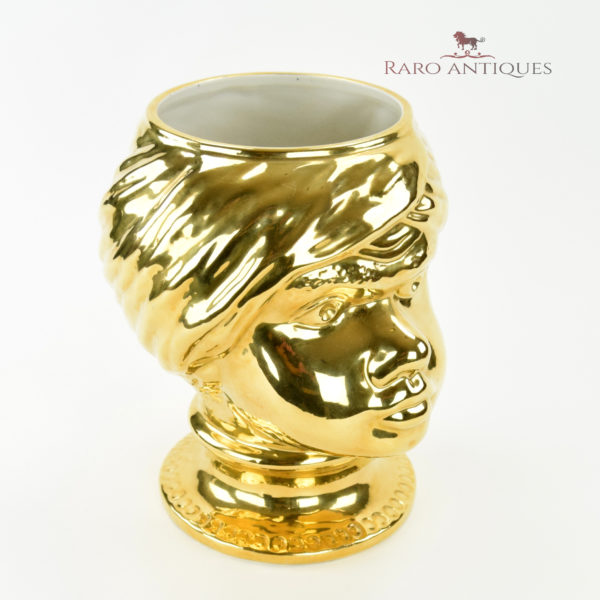
VASE PIERO FORNASETTI
Vase, by Piero Fornasetti, from the 1960s.
A gilded porcelain vase depicting the head of a Moor, by the renowned Italian artist Piero Fornasetti. This beautifully elegant and highly decorative piece will proudly draw attention in your home, adding a touch of sophistication to any space. Truly exceptional, it will serve as the perfect finishing touch to any room. At the base, you'll find the inscription "Galerie Schöninger München," indicating that it was once in their possession. Piero Fornasetti (1913-1988) was a versatile Italian artist whose work transcends categorization within any specific period. He operated according to his own principles, disregarding the norms and designs of his time. Engaging in various aesthetic disciplines including painting, drawing, graphic design, and product design, his creativity peaked in the 1950s. At the behest of Gio Ponti, he opened his studio in Milan, where he designed and created everyday objects enriched with decoration that brought art into the homes of ordinary people. As an artist ahead of his time, Fornasetti's work significantly influenced contemporary culture, reshaping taste and creating a unique and instantly recognizable style. Dimensions: 26 x 25 x 24 cm Weight: 1800 g The vase is in excellent condition.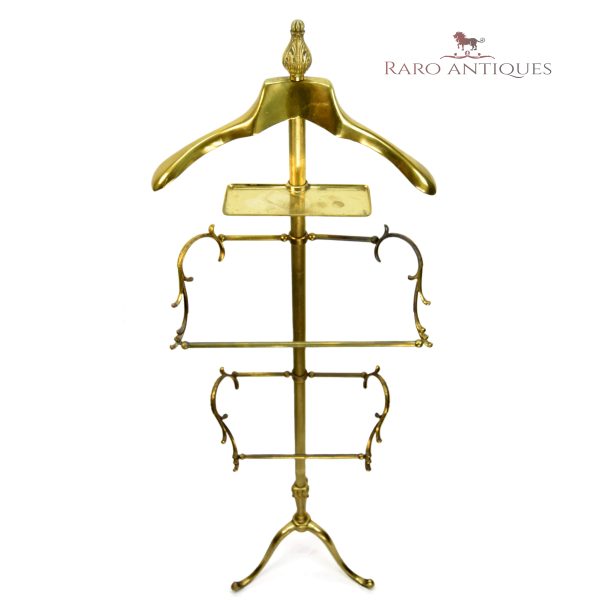
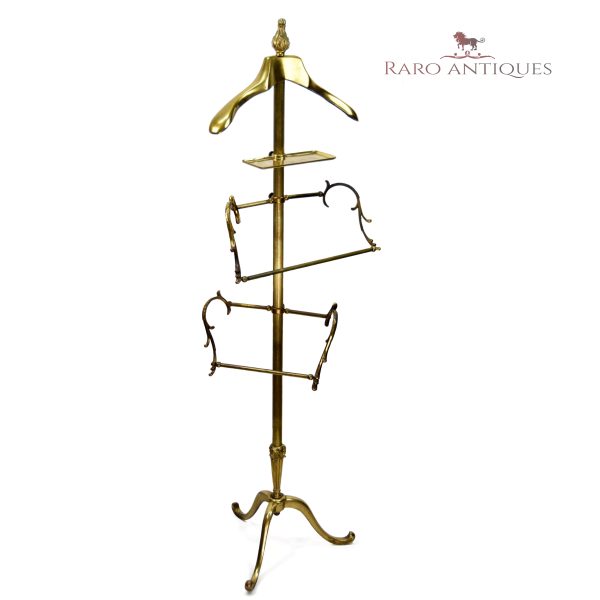
MID-CENTURY VALET STAND
Valet stand, made in the mid-20th century.
An exceptionally solid brass valet stand, an essential piece for the bedroom of anyone who appreciates well-made clothing. The stand features a brass hanger for hanging a shirt and jacket, as well as two side rails on which trousers and other garments can be neatly arranged.
The small shelf at the top is intended for cufflinks, a watch, jewellery, and other small personal items used when getting dressed. Both the shelf and the side rails are individually adjustable in height and sideways, allowing the stand to be fully adapted to personal preferences.
A beautiful piece whose outstanding design makes it a true visual highlight, while at the same time being an extremely practical accessory that helps you dress neatly and in an organised manner.
Dimensions: 136 × 42,5 × 34 cm
Weight: 5,6 kg
Valet stand is in excellent condition.


DEATH MASK
Making death masks is one of the oldest sculptural techniques, serving as a memory of the deceased or as a model for creating portraits. They are made by pressing the face of the deceased into wax or plaster, usually a few hours after death.
The particular death mask in question is original and is the first cast, as evidenced by the biological remains on the mask. Unfortunately, the identity of the man is unknown, but due to the features of the mask, it appears that he was a monk. An unusual addition to any room, carrying a profound symbolic meaning - Memento mori. Death masks are certainly one of the more intriguing traditions of humanity and a way people have preserved the memory of the deceased. The most famous death masks undoubtedly come from Egypt, where they were buried with the dead. Similarly, wax death masks from ancient Rome are known, which were used as models for carving into tombstones. A similar tradition continued for centuries until the end of the Middle Ages when they began to be made from plaster. At that time, masks began to be used in funeral rites, and then they were kept in libraries, museums, and universities. Death masks were made not only for royal members and nobility but also for prominent figures such as poets, philosophers, and playwrights. Like in ancient Rome, these death masks were often used for portraits, sculptures, busts, or engravings depicting the deceased. Dimensions: 31 x 20 x 14.5 cm Weight: 2.1 kg The mask is in excellent condition and has an iron hook for wall mounting.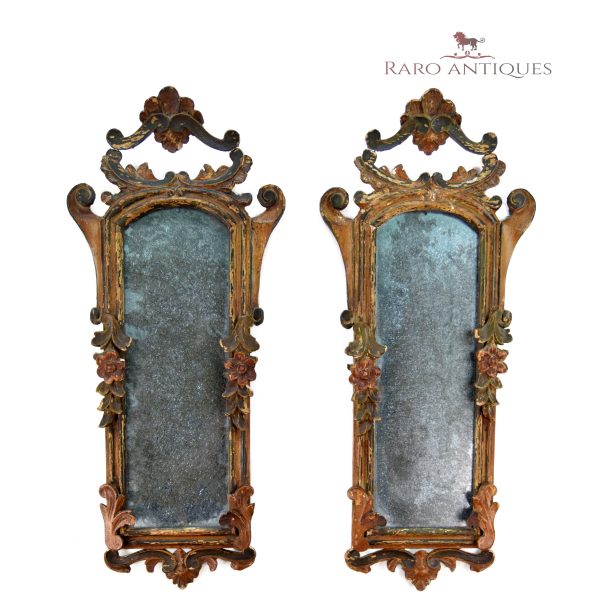
ANTIQUE VENETIAN MIRROR
Venetian mirror from the 18th century.
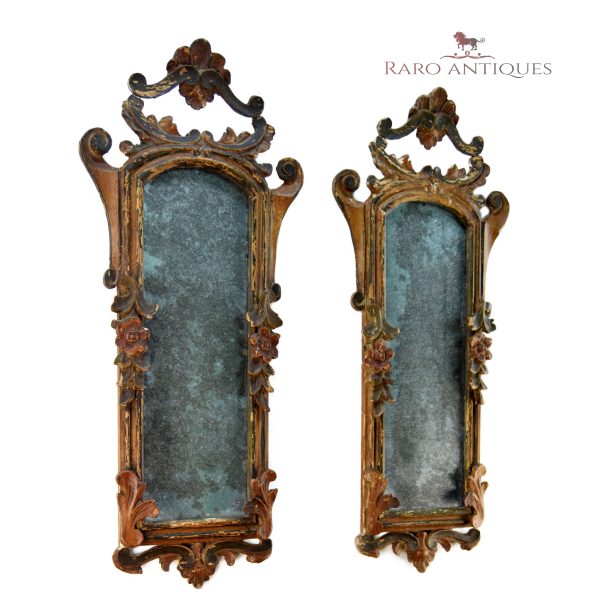
A pair of mirrors in stunning, intricately carved wooden frames, once reserved for the most affluent. During the time of their creation, mirrors were luxurious items affordable only to the wealthiest. The prestige of these pieces, crafted by master artisans, is evident in every delicate detail. Now, you have the opportunity to adorn your walls with this exceptional pair. With over 300 years of history, they exhibit remarkable patina, especially on the original mercury glass mirrors, which are no longer meant for self-reflection but for admiration. Time has crafted a unique, irreplicable image on their surface. These are true historical treasures, silent witnesses to the countless stories and individuals who once gazed into them. Dimensions: 72 x 31.5 x 5 cm Weight: 1.3 kg The mirrors are in excellent condition. Price per mirror.

ANTIQUE MIRROR
Baroque mirror, made in the 18th century.
A rare and impressive Baroque mirror, framed by a richly carved wooden frame depicting cloud motifs and featuring two tulips. The frame, adorned with a natural aged patina, presents a breathtaking combination of symmetry and elegance, characteristic of the Baroque style. The clouds subtly enveloping the mirror create a sense of softness and a heavenly ambiance, while the frame exudes luxury and sophistication. Below the mirror is a small shelf, likely intended for a candle, a typical feature of the era when mirrors were used to disperse light throughout the room. This is an exceptional decorative piece that will add grandeur to any space. Dimensions: 115 x 56 x 20 cm Weight: 11 kg The mirror is in good condition.

19TH CENTURY MIRROR
19th Century Mirror
A gilded frame with the original mirror, which has patina and painted decorations as an interesting method of "repairing" a crack that appeared on it. A mirror is not just a beautiful wall decoration but also a fundamental element in a home. Consider their presence in hallways, by entrance doors, in bedrooms, and, of course, in bathrooms as an aid for personal grooming. Mirrors can also beautifully transfer light, so they can be hung in rooms where they are not usually needed, thereby visually enhancing the space and adding some light. With old mirrors, where you can also find a wonderful patina, you bring uniqueness into your home that will inspire you for years. Dimensions: 110 x 77 x 12.5 cm Weight: 10 kg The mirror is well-preserved.

VENETIAN SALON CHAIR TESTOLINI, 19th CENTURY
Venetian salon chair, manufactured by the prestigious Testolini workshop, late 19th century.
A luxurious chair, entirely hand-carved from walnut wood and richly decorated with expressive motifs characteristic of the prestigious Venetian decorative arts of this period. It is adorned with its original relief textile upholstery featuring a rich floral pattern, further enhancing its elegance, authenticity, and historical value. Due to its size and quality of craftsmanship, such a chair was almost certainly made to order for the highest social classes, where furniture served not only as a functional object but also as a statement of status and refined taste.
Furniture from the renowned Venetian workshop Testolini later attracted collectors and admirers of decorative arts, further confirming the timeless appeal and collectible value of such pieces.
This is a rare opportunity to acquire a highly representative and collectible piece that would effortlessly fit into a prestigious interior or a refined antique furniture collection.
The Testolini company from Venice was considered one of the most prestigious names in Venetian decorative arts in the second half of the 19th century. Their richly carved pieces were intended for aristocracy and the upper social classes, valued for exceptional craftsmanship, luxurious materials, and impeccable design. Today, their works represent a symbol of refined taste and collectible exclusivity.
Dimensions: 75 × 75 × 52,5 cm
Weight: 10,5 kg
The chair is in excellent condition.


CARVED WOODEN STATUE OF JESUS, CCA.1900
Carved wooden statue of Jesus, made around 1900.
Carved from a single piece of wood, this sculpture depicts Jesus Christ after being taken down from the Cross. Such figures were intended for placement in the Holy Sepulchre during the Easter season, for Good Friday processions, or as part of larger Passion displays. The statue is finely carved, reflecting the hand of an experienced craftsman. The original polychromy, with a visible patina of age, further emphasizes the authenticity and historical character of the piece.
The figure is suitable for placement in a chapel or on a domestic altar and represents a fine example of sacral art from the turn of the 19th to the 20th century. It will surely attract the interest of collectors and admirers of religious heritage.
Dimensions: 51 × 18,5 × 15,5 cm
Weight: 3,8 kg
The statue is in good condition.


BRUTALIST CANDLESTICK
Brutalist candlestick from the 1960s.
A massive candlestick, an excellent representative of the brutalist period, will be a great addition to any table or shelf, as it will attract attention even without a candle. It's not just an ordinary candlestick; it's a true artistic sculpture that won't go unnoticed. Candlesticks are a welcome ornament in any home. They can illuminate a festive dinner in the dining room or create a romantic atmosphere in the bedroom. However they're used, candlesticks are certainly one of those items that come in handy on every occasion. Dimensions: 19 x 10.5 cm Weight: 850 g The candlestick is in excellent condition.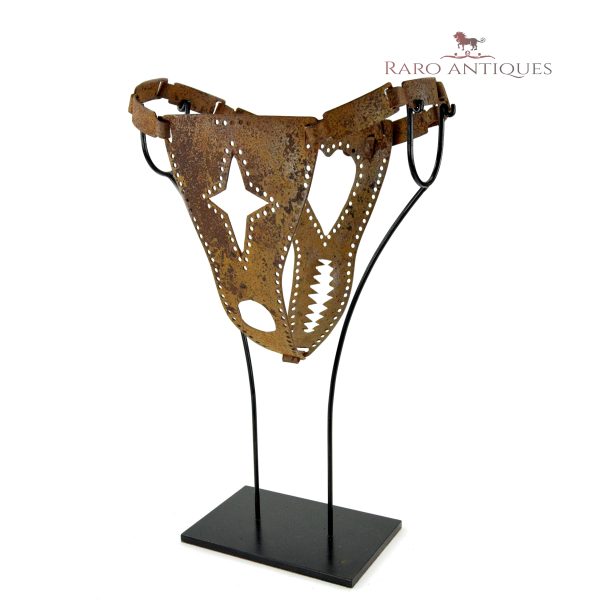
CHASTITY BELT
The chastity belt.
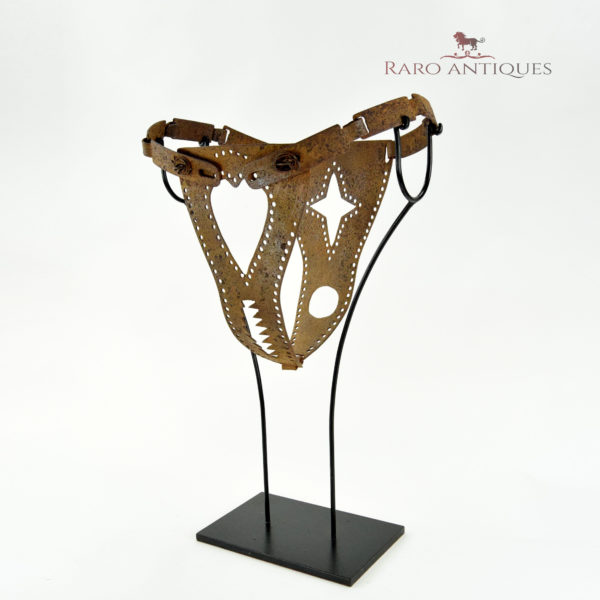
Who hasn't heard of the chastity belt? A device that supposedly helped husbands and fathers ensure that their wives and daughters remained untouched and "pure" as far back as the Middle Ages. This was said to be a metal belt tightened around a woman's waist, locked by the man with a large padlock. This medieval man could then be free of worries that his chosen one would engage in sexual relations with someone else, despite their prolonged absence due to wars. How barbaric and unhygienic, isn't it? At least that's the story that has been told for centuries. Simple, shocking, and somewhat amusing, as it portrays past people as extremely backward, contrasting with our enlightened and better selves. However, this is not the true story of the chastity belt. The truth is, there is no physical evidence that chastity belts existed in those times, at least not in a physical form. They are mentioned a few times in literature and depicted in artworks, albeit more in an allegorical and satirical sense. The earliest evidence of a chastity belt can be found in a book by military engineer von Eichstadt from 1405, which described catapults, armor, and torture devices, including a sketch of a chastity belt. Historians are convinced that this was just one of the humorous inventions he included in the book, similar to a device for becoming invisible or a fart-propelled contraption, which further solidifies the fact that chastity belts were not used in the Middle Ages. The surviving examples of chastity belts found today are believed to have been made in the 19th century. With the advent of industrialization in Europe, materials such as iron and steel became more accessible, and soon blacksmiths realized there was a particular market they could tap into. Puritanical masses of that time were willing to pay a lot of money to view medieval torture devices in museums and exhibitions, satisfying their craving for their own judgment of medieval barbarism. Thus, blacksmiths of that time made several torture devices, including chastity belts, and sold them to museums and collections. Interestingly, the chastity belt probably was never in widespread use in the past, but its use has spread precisely in modern times, in BDSM and fetish communities. Thus, the chastity belt is an urban legend of the Middle Ages that has survived to this day. Now it can be an interesting addition to any historical collection or a fascinating ornament to spark debates. Certainly, one of those pieces that tell a story and stimulate our imagination. Dimensions: 55 x 35 x 25 cm Weight: 4 kg The chastity belt is in excellent condition.

ARTEMIDE TABLE LAMP, 1970s
Table lamp, model Dalù, manufactured by the Italian company Artemide in the 1970s.
Vintage pair of Dalù table lamps designed by Vico Magistretti for the Italian company Artemide. This is one of the most iconic models of Italian space age design, originally conceived in the mid-1960s. Thanks to its futuristic silhouette, the Dalù lamp was soon recognized as one of the most distinctive pieces of modernist design.
This pair is particularly interesting because they come from an early Italian production, confirmed by the embossed marking on the underside of the lamps and the metal spring used to hold the electrical cord.
For this reason, they are appealing both to collectors and interior design enthusiasts, while their futuristic appearance allows them to fit beautifully into almost any interior.
Dimensions: 26 x 18,5 x 17,5 cm
Weight: 0,6 kg
The lamps are in excellent vintage condition. Suitable for E14 bulb. Price for one.
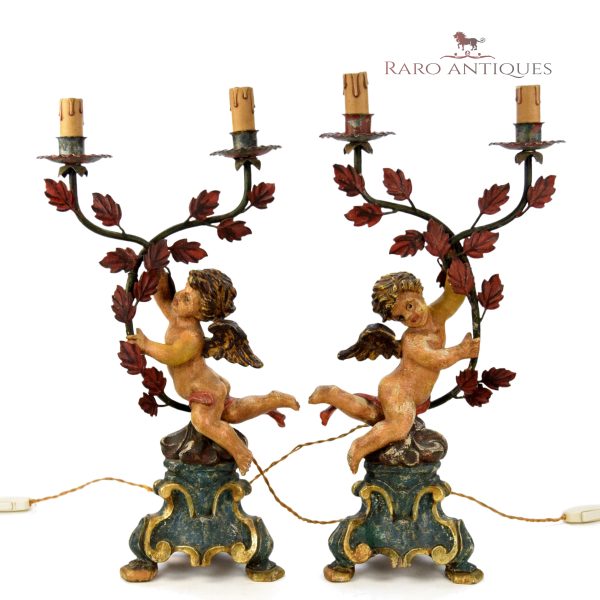
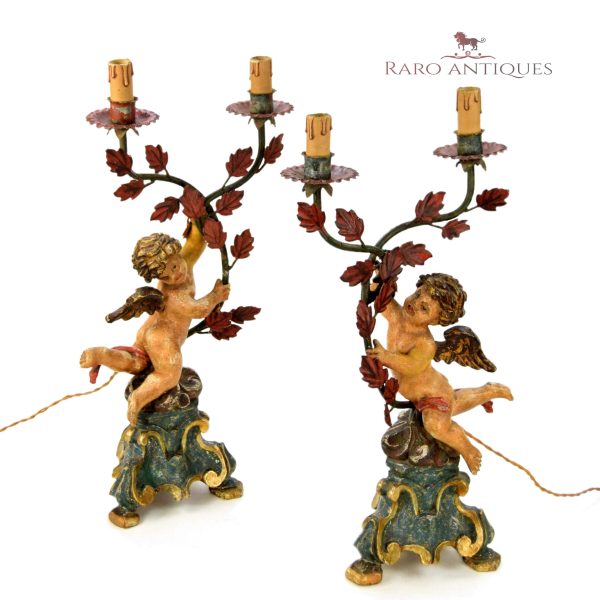
ANTIQUE DECORATIVE ANGEL LAMP
Decorative angel lamp, made in the first half of the 20th century.
A beautiful pair of table lamps featuring a hand-carved and hand-painted cherub, with metal arms shaped like foliage supporting the lights. An exceptional decorative and functional piece that brings a romantic atmosphere and classic elegance into any interior.
Dimensions: 53 × 27 × 17,5 cm
Weight: 1 kg
The table lamp is in good condition. Suitable for two E14 bulbs. Price is for one lamp.


SPRING-LOADED CANDLE HOLDER DITMAR
Spring-loaded candle holder made by the Ditmar company, produced between 1895 and 1907.
A rare example of a perfectly preserved spring-loaded candle holder. The candle holder, with its spring, allows you to adjust the height of the candle so that, regardless of the candle's length, it always stays at the same height. An interesting addition to a festive table or a shelf where you can always admire it. Karl Rudolf Ditmar, the founder of the Ditmar company, was born on May 3, 1818, in Prenzlau - Brandenburg. He came to Vienna in 1839. During a business trip to Paris, he is said to have encountered the still-controversial, heavy-working moderator lamp. Improving these lamps soon became his main concern. On August 5, 1840, Ditmar founded a trading company dealing with oil lamps, cups, and lacquered tin. The next step was establishing a workshop for lamp repairs, followed by an attempt at in-house production. Together with his brother Friedrich, whom he invited to Vienna, Rudolf led the company as "Gebrüder Ditmar" in 1841. For this purpose, a "state permit for the production of lacquered tin and zinc composite goods" was issued, creating a legal basis for the first lamp factory in Vienna and Austria. During this time, the brothers succeeded in developing the "Viennese moderator lamp," a spring-loaded lamp that was both inexpensive and reliable due to its adjustable oil supply. After the death of his brother Friedrich in 1858, "Gebrüder" was removed from the company's name, and it became Lampen Fabrik R. Ditmar. Even after his death in 1895, the company retained his name and tradition. Dimensions: 41 x 11.5 cm Weight: 510 g The spring-loaded candle holder is in excellent condition.

ANTIQUE TABLE
Antique table, crafted in the 18th century.
This table boasts an exceptional history, which can be felt when touching its surface and observing the small details that only an object serving its purpose for centuries can acquire. Enrich your home with a table that not only brings utility but also carries a story within. Tables like these were commonly used in taverns, workshops, and even found their place in wealthier rural homes. Its distinctive feature is the wooden pegs that secure the tabletop, making it easily disassembleable. Its simple lines allow it to fit into any style, whether it's your dream dining table, a kitchen island, or a side table in another room. We are confident that its charm will inspire anyone. Dimensions: 115 x 83 x 77 cm Weight: 12.5 kg The table is excellently preserved.

GILDED WROGHT IRON WALL LAMP, CCA. 1950
Wrought iron wall lamp, made in the 1950s.
A monumental wall lamp, entirely hand-forged and gilded. Over the decades, the gilding has developed an exceptional patina, while the forged lattice structure gives it a subtle Gothic character, further enhancing the artistic impression of this remarkable piece. Such monumental lighting pieces were often featured in the interiors of villas, prestigious hotels, Mediterranean residences, and rustic ambiences throughout the last century.
If you are looking to enrich your interior not only with light, but also with a true artistic statement piece from the mid-20th century, this lamp is the perfect choice.
Dimensions: 63 × 33 × 23,5 cm
Weight: 11,5 kg
The wall lamp is in excellent condition. Requires six E14 bulbs.


ART NOUVEAU MIRROR
Hand Mirror from the Art Nouveau Period.
A hand mirror, once used by a lady to check her appearance, is now a unique and beautifully crafted piece of art. The mirror is shaped like a pond, with a girl sitting by it, gazing into the water and pinning a flower in her hair. The delicate details on the mirror, such as grass blades, water lilies, and a frog, are surprising. Due to the strong patina of the mirror, it becomes an even more special piece, creating the illusion of real water and mud in the pond. Such mirrors are a rarity today and are highly sought after by collectors. Nowadays, this mirror will certainly no longer serve its original purpose but will be an excellent decorative piece that will inspire us with its playfulness and bring a smile to our faces. Dimensions: 16 x 13 x 7 cm Weight: 400 g The mirror is in excellent condition, bearing the marks of time, which only adds to its charm and enchantment.

SIGNED BRONZE SCULPTURE OF JESUS
Bronze sculpture of Jesus Christ, signed, created in the second half of the 20th century.


ANTIQUE MEDICAL CHEST
19th-century medical chest, made in France.
This rare wooden medical chest is a relic from the era when home remedies were essential, especially for families living far from cities and medical care. Such chests were used to store a variety of medicinal preparations to provide aid for all family members. This particular chest contains 19 glass bottles, some still holding remnants of their original contents, a wooden case for a thermometer, antique gauze, and a small box with a glass syringe accompanied by various ampoules, also retaining their original contents. Due to its remarkable preservation, this piece is a true museum artifact, ideal for collectors, medical history enthusiasts, and lovers of historical treasures. Exploring its contents is an educational journey, while the chest itself serves as an unusual and fascinating decorative item. Dimensions: 44 x 29 x 19 cm Weight: 7.7 kg The medical chest is in excellent condition.

BAROQUE ANGEL
Angel, made in the 18th century.
An exceptional pair of hand-carved angels with original polychromy. The figures are surrounded by characteristic Baroque clouds. Particularly notable is the fact that they form a matched pair, with one designed for the left and the other for the right side, allowing for a balanced and symmetrical wall display. As such, these angels represent a rare and high-quality example of Baroque sculpture, serving as both a decorative and symbolic object.
Dimensions:
left: 22 × 21 × 9 cm
right: 23 × 17 × 10 cm
Weight: 0,5 kg
Angels are well preserved. Price per angel.


ANTIQUE HOME ALTAR
Home altar, made circa 1870.


ANTIQUE BUST SCULPTURE
Antique bust sculpture, created in 1906, by Italian sculptor Emilio Marsili.
The bust sculpture of an elderly man will be an intriguing addition to your home or institution. You can hang it on the wall or place it on a shelf/table. The sculpture has been evaluated by the museum in Rome, ensuring that you'll be bringing top-notch art from the previous century into your spaces. This offers you an excellent opportunity to own a piece by the esteemed sculptor, whose works are otherwise displayed in museums. Emilio Marsili was born in Venice in 1841. He trained as a sculptor at the Venetian Academy under L. Ferrari, then moved to Paris, where his Venetian education flourished, making him extremely popular. After Paris, he moved to Belgium, inspired by the sculptors there. However, homesickness drew him back to Venice, where he continued to dedicate himself to his craft. During that time, he contributed to the remodeling of Palazze Cavalli Franchetti, created a bust sculpture of Vittorio Emanuele II for the town hall in Pordenone, and crafted a relief for the facade of the Pietà church in Venice, which can still be found there today. In those years, he also received his first recognitions for his work, not only in his native Italy but also receiving awards in Vienna and Paris, with museums beginning to acquire his works. He was described as an "aristocratic artist" endowed with "an instinctive sense of measure, allowing him to be lively without being vulgar and strict without being harsh." In later years, he became known primarily for crafting prestigious tombstones, including one for Queen Margherita of Savoy. He passed away in 1926 in Venice, and his works remain part of museums today, highlighting his enduring creative energy, which is still appreciated to this day. Dimensions: 68 x 65 x 40 cm Weight: 12 kg The bust sculpture is well-preserved and signed.

BANCI FIRENZE WALL LIGHT
Wall light, crafted in the 1960s by the prestigious Banci company in Florence.
This handcrafted, gilded wall lamp is adorned with glass ornaments and is not just a lighting fixture, but a true work of art. This exceptional light will elevate any space, bringing that special touch that only a high-quality product, crafted by multiple generations of skilled artisans, can provide. Undoubtedly a wall lamp that will not go unnoticed.
Banci Firenze – named after its founder Giuseppe Banci, who first opened his shop in 1899, initially as a store, later adding a workshop where chandeliers and mirrors were restored. They quickly gained a reputation as skilled artisans, working in the traditional ways and using the same materials. The neighborhood where Banci was located had been known since medieval times as a hub of artists and craftsmen, renowned worldwide for its master blacksmiths. Thanks to this guild, Florence became an economic powerhouse and a meeting place for famous artists and artisans.
In the 1930s, inspired by the city’s history and the knowledge he had gained over years of restoration work, Giuseppe Banci, together with his children Gaston and Ghita, began producing the first “Banci” chandeliers. Although Gaston passed away young, Ghita continued the craft, and later three of Gaston’s children joined the company. This generation elevated Banci to new heights, expanding sales internationally and creating new lamp models. This led to new collections and unique pieces, blending one-of-a-kind creations with small-batch production. Today, Jacopo Banci works alongside his father Massimo, making Banci a company with over 100 years of history, spanning four generations, and representing Florence’s cultural and artisanal pride.
Dimensions: 54 x 31 x 8 cm
Weight: 2 kg
The wall lamp is in excellent condition. Fits two E14 bulbs.