


VINTAGE FREESTANDING MIRROR
Vintage freestanding mirror from the second half of the 20th century.
A freestanding mirror, on a sturdy brass stand, with the back dressed in beautiful fabric, will be an exceptional addition to the hallway, bathroom, or bedroom, allowing you to always check yourself from head to toe. It would also fit remarkably well in a clothing boutique or fashion studio. Due to its adjustable tilt, it is extremely versatile, and because of its exceptional details, it is also an excellent decorative piece. The mirror is not just a beautiful ornament for the wall but is one of the key elements in a home. Think about it; we have them in hallways, at entryways, in bedrooms, and last but not least, in bathrooms, serving as a tool for personal grooming. Mirrors can also be a wonderful source of light, so we can hang them in rooms where they are not typically needed, visually enhancing the space and adding some brightness. With old mirrors, which also exhibit a beautiful patina, we bring uniqueness into our homes, inspiring us for years to come. Dimensions: 166 x 56 x 48 cm Weight: 18 kg The mirror is in excellent condition.

ANTIQUE CHANDELIER
Antique chandelier from the Art Nouveau period, crafted between 1900-1910.
An exceptional chandelier made of chased brass and adorned with beautiful glass pendants. It features depictions of dragonflies and flowers, making it even more unique. This chandelier is extremely decorative and elegant, transcending its function as a mere light fixture to become a work of art that will be admired by all. Dimensions: 98 x 62 cm Weight: 6.5 kg The chandelier is excellently preserved and rewired. Suitable for four E27 bulbs.

GOTHIC KEY
Key, from the 14th – 15th century.
This exceptionally large Gothic key is a true rarity and an incredibly important piece of the past. It most likely once opened the doors of a castle, manor, or church. At the time of its creation, keys were symbols of wealth, as having a key meant owning property that was worth protecting. During this period, keys were made with great craftsmanship and to the highest standards. As seen in the presented key, the ornamentation reflects Gothic architecture, and the key's design often symbolized the doors it opened. This stunning example of a Gothic key, due to its excellent condition, is ideal for collectors of medieval artifacts. As a decorative piece, it will undoubtedly spark many discussions. Dimensions: 26 x 10 x 2.5 cm Weight: 0.4 kg The key is in excellent condition.

ART NOUVEAU MIRROR
Hand Mirror from the Art Nouveau Period.
A hand mirror, once used by a lady to check her appearance, is now a unique and beautifully crafted piece of art. The mirror is shaped like a pond, with a girl sitting by it, gazing into the water and pinning a flower in her hair. The delicate details on the mirror, such as grass blades, water lilies, and a frog, are surprising. Due to the strong patina of the mirror, it becomes an even more special piece, creating the illusion of real water and mud in the pond. Such mirrors are a rarity today and are highly sought after by collectors. Nowadays, this mirror will certainly no longer serve its original purpose but will be an excellent decorative piece that will inspire us with its playfulness and bring a smile to our faces. Dimensions: 16 x 13 x 7 cm Weight: 400 g The mirror is in excellent condition, bearing the marks of time, which only adds to its charm and enchantment.

VINTAGE PORCELAIN STATUE OF A GREAT DANE DOG
Vintage porcelain statue of a Great Dane dog, in life size. Made in Italy, in the mid-20th century.
Great Danes, also known as "gentle giants," are one of the largest dog breeds in the world. Due to their calm demeanor and majestic appearance, they are extremely popular. Once used as wild boar hunters, the tradition of cropping their ears originated from the belief that it protected them from injuries. Nowadays, this practice is fortunately declining, as they are primarily kept as family pets. It's no wonder that this interesting and beautiful breed is often depicted in artworks and even on the silver screen, with the most famous cinematic representation being Scooby-Doo. This particular statue of a dog is life-sized, and its features are crafted exceptionally realistically, ensuring that this remarkable sculpture will not go unnoticed. Dimensions: 96 x 65 x 33 cm Weight: 18.5 kg The statue of the dog is excellently preserved.

TABLE LAMP FONTANA ARTE
Table lamp, from the 1940s, produced by the renowned Italian company Fontana Arte.
A pair of exquisite table lamps, designed by Pietro Chiesa. They will perfectly complement bedside tables or shelves, creating an exceptional ambiance. Crafted from intricately engraved glass, with brass accents adding the finishing touch, these lamps are truly special. Pietro Chiesa, born in 1892 into the renowned Ticino artistic family, opened his own glass workshop, Bottega di Pietro Chiesa, in 1921 after apprenticing with furniture designer Giovan Battista Giannotta. He blended exceptional modernity with high technical knowledge in his work, creating stained glass for the Trieste stock exchange, the motor ship Victoria, and the transatlantic Conte di Savoia. In 1932, Gio Ponti invited him to join Fontana Arte as artistic director, a role that allowed him to express his creativity by designing over a thousand different items, including furniture, tables, lamps, windows, and artworks. Chiesa passed away in Paris in 1948. Fontana Arte originated from Luigi Fontana's glass plate manufacturing company established in 1881, which achieved great success in the construction sector, becoming one of Italy's largest glass producers. In the early 1930s, Fontana aimed to venture ambitiously into the artistic glass and decor market, hiring renowned Italian designer Gio Ponti to assist. Thus, in 1933, Fontana Arte was born, merging the same year with Pietro Chiesa's company, Bottega di Pietro Chiesa. Gio Ponti and Pietro Chiesa became the company's artistic directors. They quickly gained recognition and esteem for their refined glass products, including stained glass, lighting, mirrors, and even glass furniture. In the post-war years, amid economic turmoil, they continued crafting prestigious pieces, primarily for hotels and offices. In 1954, Max Ingrand took over as artistic director, ushering the company into a new era of success. With his creations, they regained prestige and acclaim. Fontana Arte went through several ups and downs but managed to survive to the present day. In 1998, Fontana Arte was even awarded the ADI Compasso d'Oro for its significant contribution to Italian design heritage. Today, they continue their design endeavors, collaborating with many 21st-century architects and designers. Their notable works can be found in prestigious museums such as the Museum of Modern Art in New York, where they are part of the permanent collection. Dimensions: 18 x 14.5 cm Weight: 580 g The table lamps are in excellent condition. For E14 bulbs. Price is for one.

ANTIQUE CHAIR
Antique chair, made in England between 1750 and 1850.
This chair is a typical example from the late 18th to early 19th century. It features a drawer under the seat, providing storage for various items. Due to its solidity, it's incredibly eye-catching, making it an excellent piece for highlighting and enriching a space. The chair itself boasts other wonderful details that only such an old piece can have. These include wooden pegs, which often replaced expensive iron nails in those times since they were hand-forged. Another detail is the beautifully patinated wood, which, upon touch, tells the story of its rich history. Most captivating is its shape, as the chair is not precisely formed and exhibits many asymmetrical details, lending it a playful naivety and confirming that it was entirely handmade, without the aid of mechanized tools. The story behind the chair with a drawer is also fascinating, as there are several versions. One story suggests that such chairs were made on farms in England for those assisting in lambing. The person would sit on this chair, waiting for the lambing, with a drawer under the seat containing a Bible and whisky to sustain them. These chairs were typically made by carpenters not accustomed to furniture-making, which explains the asymmetrical shape. Another tale suggests that such chairs were found in wealthier households, known as "salt thrones" as they stored salt, a prestigious spice at the time, in the drawer. Sitting on such a chair during a meal signified a special honor, as being seated above the salt was a mark of distinction. Thus, this chair is a true throne of history, capable of telling many stories of the past and inspiring us with its grandeur. Dimensions: 97 x 57 x 50 cm Weight: 18 kg The chair is excellently preserved.

VASE PIERO FORNASETTI
Vase by Piero Fornasetti from the 1960s.
A vase depicting the face of a Moor, created by the renowned Italian artist Piero Fornasetti. An elegant and highly decorative addition. Piero Fornasetti (1913-1988) was a versatile Italian artist who is challenging to categorize within a specific period. He operated based on his principles, without adhering to the norms and designs of his time. Engaging in various aesthetic disciplines, including painting, drawing, graphic design, and product design, Fornasetti reached the height of his creativity in the 1950s. Encouraged by Gia Ponti, he opened his studio in Milan, where he designed and crafted everyday objects enriched with decorations that brought art into the homes of ordinary people. Recognized as an artist ahead of his time, Piero Fornasetti made a significant contribution to the renewal of taste and the creation of a unique and immediately recognizable visual language in contemporary culture. Dimensions: 27 x 21 cm Weight: 2.1 kg The vase is in excellent condition, with some minor wear on the gold color in certain areas.

ANTIQUE CHANDELIER
Chandelier from the Art Nouveau period made in Vienna, between 1900-1910.
An exceptional Viennese Art Nouveau chandelier with five lights. Its brass frame is adorned with an elegant, linear design characteristic of the Viennese Art Nouveau movement. An extremely decorative and elegant chandelier, it is undoubtedly not just an ordinary light but an artwork that will be admired by all. Dimensions: 45 x 40 cm Weight: 3.9 kg The chandelier is in excellent condition, newly wired. For five E27 bulbs.

TRAMP ART MIRROR
Tramp art mirror.
An exceptional tramp art frame with a mirror. It is crafted from wooden cigarette boxes, which can be seen in the background of the frame, confirming its authenticity. The romantic touch to the frame is the heart at the top. An intriguing addition to your bathroom, hallway, or foyer. Tramp art, also known as "hobo art," was popular from around the 1870s to the 1940s. Nobody knows exactly when it began, but the materials used, especially wooden cigarette boxes, became standard around the 1850s. Smoking cigarettes was very popular at the time, and by law, cigarette manufacturers couldn't reuse the boxes, making them an excellent source of material. Tramp art is believed to have evolved from the folk art tradition of carving. Cigar boxes and pieces of wood from dismantled wooden crates were carved and pieced together, creating picture frames, decorated boxes, and even items of furniture. The style is said to have originated from Germany and Scandinavia but can be found in all industrialized countries. The name comes from the myth that tramp art was created by hobos and that they would typically exchange their creations for food and shelter. Although there is some truth to this myth, many tramp art creators were skilled artisans who devoted much time to their creative endeavors. Most tramp art pieces are not signed or dated, adding to the mystique surrounding them. Dimensions: 64.5 x 45 x 2.5 cm Weight: 2.8 kg The mirror is excellently preserved.

BAROQUE DISPLAY CABINET
Baroque Display Cabinet.
An exceptional display cabinet from the Baroque period, where rich religious sculptures were likely exhibited in their time. The cabinet is exquisitely crafted, originally intended as a corner cabinet, but later expanded, adding to its charm. The modification was done with high quality, further emphasizing its true age and value. Today, it is equally excellent for showcasing sculptures, figurines, and other items. Dimensions: 89 x 66 x 30 cm Weight: 13 kg The cabinet is in excellent condition.

BIEDERMEIER CHANDELIER
Biedermeier chandelier from the early 19th century.
An exceptional wooden chandelier, originally designed for candles, has been electrified to illuminate your home or business space. This chandelier is a true representation of the luxury of bygone times. With wooden details on both the chain and the frame, it is a timeless piece that complements almost any style. Dimensions: 95 x 85 cm Weight: 3.2 kg The chandelier is in excellent condition. Suitable for six E14 light bulbs.

VINTAGE COFFEE TABLE
Vintage coffee table made in Italy in the 1960s.
An interesting wooden coffee table with a painted stone-like surface covered with glass. Enhance your living room or lounge with this exceptional table that will undoubtedly become the centerpiece of the room. Dimensions: 88.5 x 48.5 x 40 cm Weight: 8 kg The table is in excellent condition.

SCOLD’S BRIDLE
The scold's bridle.
The scold's bridle or brank, originating from Scotland in the 16th century, was a horrific device designed to cause shame, discomfort, and pain to its wearer. Its usage spread from Scotland to England, Germany, and other European countries. Its purpose was to shame, silence, and physically discomfort individuals who were deemed unruly or outspoken, particularly women who challenged authority or societal norms. Often, these bridles were crafted to resemble masks with distorted facial features, such as large ears, noses, or horns. Some even had bells attached to them, further humiliating the wearer and drawing attention to their presence. The bridle, worn for a minimum of several hours, prevented its wearer from eating, drinking, and most importantly, speaking. It consisted of a metal part inserted into the mouth, similar to a bit in a horse's harness, which held the tongue in place. In more severe cases, these metal mouthpieces had spikes, causing additional pain. The bridle was predominantly used as a punishment for women who were considered too vocal or contentious in public, especially widows or older women who were not under male control. It was also known as a "witch's bridle," indicating its use during witch trials to prevent accused witches from casting spells on their captors or communities. Additionally, disobedient wives could be subjected to this punishment at their husbands' request. While men could also face this punishment if perceived as a threat to the common good, it was primarily reserved for women deemed gossips, adulterers, prostitutes, or witches, as well as those who defied societal norms. The bridle served as a stark reminder of the oppression women faced and the consequences of expressing dissent in conservative societies. Remarkably, this punishment was not abolished in England until 1967, reflecting the enduring legacy of patriarchal control and the gradual progress towards women's rights. The scold's bridle serves as a poignant relic of the past, prompting reflection on the darker aspects of human history. Dimensions: 26 x 25.5 x 21 cm Weight: 3.2 kg The scold's bridle is in excellent condition, complete with a lock and accompanying key.

VINTAGE CONSOLE TABLE
Vintage console table from the 1950s, made in Italy.
This table is wooden, with glass shelves and brass details on the legs and drawers, while its extravagance is accentuated by the back covered in artificial snakeskin. As a console table, it is truly something special and suitable for almost any space, particularly living rooms, hallways, foyers, as well as commercial spaces and restaurants. Its narrow design means it will fit easily into any space, while offering excellent storage with two shelves and two drawers. An excellent example of Italian design, timeless and versatile regardless of space or time. Dimensions: 109 x 93.5 x 32 cm Weight: 19 kg The console table is in excellent condition.

ANTIQUE TABLE LAMP
Table lamp, from the early 20th century, made in France.
A pair of exceptional brass table lamps in the Empire style. They are richly decorated with lion paws and swans, all finished with a concave triangular base. If you're looking for a richly detailed and extremely attractive lamp for your bedside table or desk, you certainly won't go wrong with this lamp. Dimensions: 31 x 15 cm Weight: 520 g The table lamps are in excellent condition. For E14 bulb. Price is for one.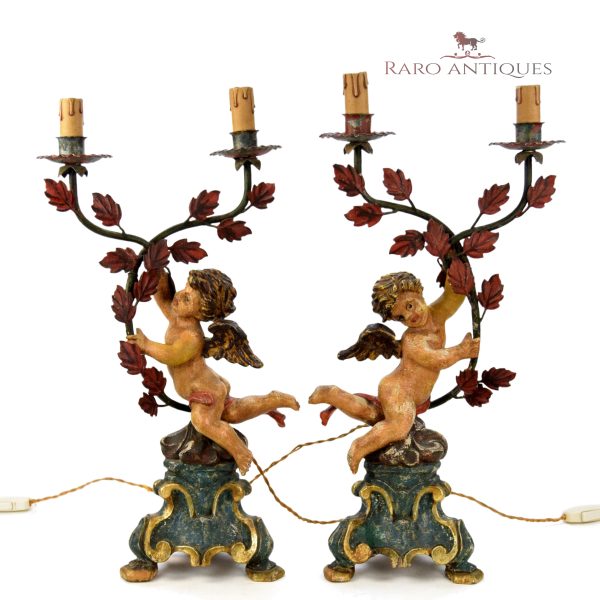
ANTIQUE DECORATIVE ANGEL LAMP
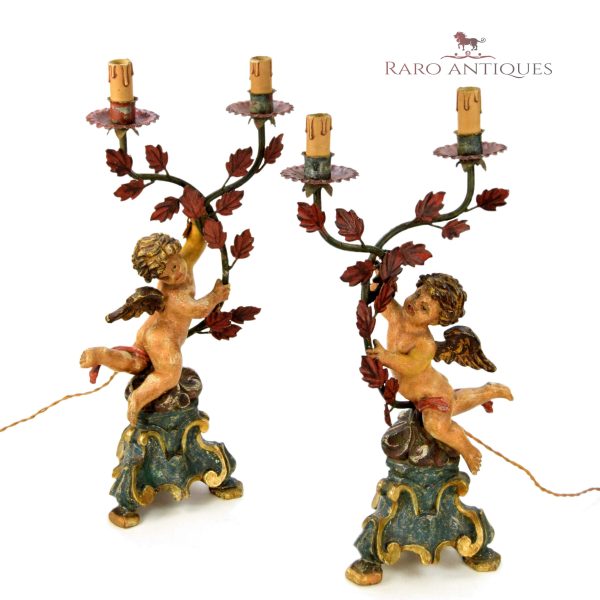
Decorative angel lamp, made in the first half of the 20th century.
A beautiful pair of table lamps featuring a hand-carved and hand-painted cherub, with metal arms shaped like foliage supporting the lights. An exceptional decorative and functional piece that brings a romantic atmosphere and classic elegance into any interior.
Dimensions: 53 × 27 × 17,5 cm
Weight: 1 kg
The table lamp is in good condition. Suitable for two E14 bulbs. Price is for one lamp.


19TH CENTURY MIRROR
19th Century Mirror
A gilded frame with the original mirror, which has patina and painted decorations as an interesting method of "repairing" a crack that appeared on it. A mirror is not just a beautiful wall decoration but also a fundamental element in a home. Consider their presence in hallways, by entrance doors, in bedrooms, and, of course, in bathrooms as an aid for personal grooming. Mirrors can also beautifully transfer light, so they can be hung in rooms where they are not usually needed, thereby visually enhancing the space and adding some light. With old mirrors, where you can also find a wonderful patina, you bring uniqueness into your home that will inspire you for years. Dimensions: 110 x 77 x 12.5 cm Weight: 10 kg The mirror is well-preserved.
ANTIQUE CANDLESTICK
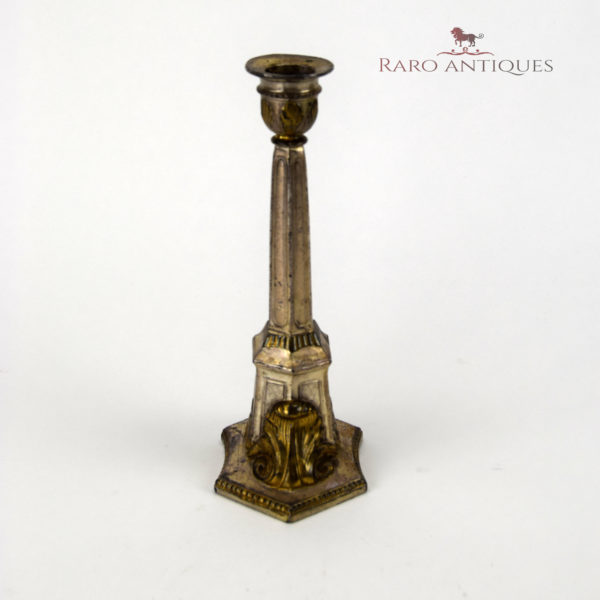
Very interesting and decorative candlestick.
It has ink traces on it, which especially captivate us, as we can imagine someone writing a letter by candlelight, and such a simple detail immediately transports us into the past. Candlesticks are a welcome decoration in any home. They can be placed in the dining room to brighten up a festive dinner, or in the bedroom to create a romantic atmosphere. However they are used, candlesticks are undoubtedly one of those items that come in handy on every occasion. Dimensions: 21.5 x 11 cm Weight: 560 g The candlestick is in excellent condition."

LARGE POLYCHROME TERRACOTTA SCULPTURE, ITALY, CCA. 1900
Large polychrome terracotta sculpture, made in Italy, circa 1900.
This unusually large terracotta sculpture immediately evokes the seaside, masterfully depicting two boys caught in a moment of carefree play. The composition feels light and full of life, while the modeling of the figures is exceptionally convincing: the bodies are naturally formed, the movement relaxed, and the facial expressions rich in character. The sculptor captured not only form, but also mood, revealing the hand of a highly skilled artist.
The original polychromy shows the gentle traces of time, with a patina developed over decades that is not a flaw, but an integral part of the sculpture’s story. Along the edges of the shell, small and very carefully executed older restorations are visible; they blend harmoniously into the whole and attest to the long life of this remarkable piece.
The sculpture is unsigned, which is characteristic of high-quality decorative terracotta sculpture from this period.
Due to its impressive size, rare level of craftsmanship, and strong expressive presence, this is an outstanding artistic object. It is ideally suited to be displayed as a standalone focal point in an interior, where it will draw attention through both its playful subject matter and exceptional sculptural quality.
Dimensions: 61 × 34 × 30 cm
Weight: 6,2 kg
The sculpture is in good condition.
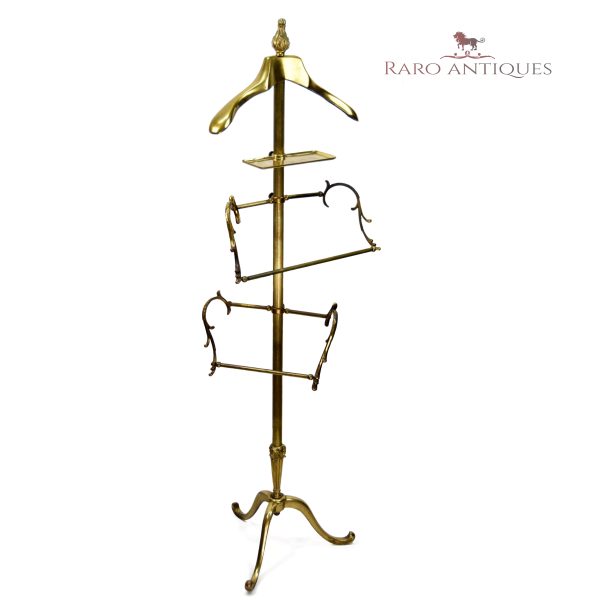
MID-CENTURY VALET STAND
Valet stand, made in the mid-20th century.
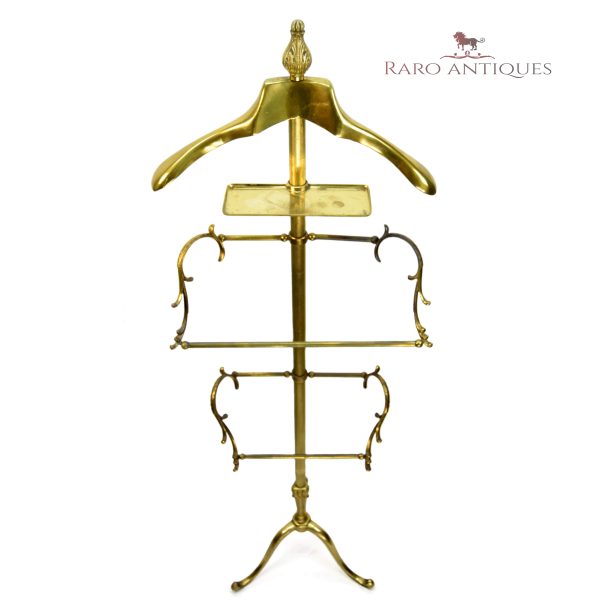
An exceptionally solid brass valet stand, an essential piece for the bedroom of anyone who appreciates well-made clothing. The stand features a brass hanger for hanging a shirt and jacket, as well as two side rails on which trousers and other garments can be neatly arranged.
The small shelf at the top is intended for cufflinks, a watch, jewellery, and other small personal items used when getting dressed. Both the shelf and the side rails are individually adjustable in height and sideways, allowing the stand to be fully adapted to personal preferences.
A beautiful piece whose outstanding design makes it a true visual highlight, while at the same time being an extremely practical accessory that helps you dress neatly and in an organised manner.
Dimensions: 136 × 42,5 × 34 cm
Weight: 5,6 kg
Valet stand is in excellent condition.


VINTAGE NEON SIGN
Vintage neon sign "Apollo11", from the early 1970s.
A rare neon sign with original working neon tubes. Want something extraordinary in your home? Something out of this world? Then this is the perfect decorative piece for you. It will stand out in any home or establishment, captivating everyone with its size and neon lights in three colors. Due to its association with the first manned Moon landing, it's not just a collector's item but also a reminder of a historic event that will remain in the collective memory of humanity and an unforgettable moment in global culture. Apollo 11 was the first manned space mission to land on the Moon. In 1969, when the landing occurred, millions of people were glued to their television screens, as the Moon landing had been a subject of fascination for years. People were anxious, not knowing what might befall the first astronauts. Would they encounter extraterrestrials? Would harmful radioactive rays kill them? There were more questions than answers, but people were still more curious and excited than frightened, thrilled that humanity could land on the moon and even travel through space. The successful landing and subsequent return to Earth thrilled humanity and inspired the imagination for years to come. It was and will forever be a story of what is possible with science, technology, and the will to achieve the impossible. Therefore, it's not surprising that during that time, people almost worshipped the Apollo 11 mission and produced items with a space theme. The first neon lights appeared as early as 1890, but they were used exclusively for industrial purposes, such as by miners in France who had neon lamps. Neon lights as we know them today appeared around 1910 when they were invented by French innovator Georges Claude. The first neon sign was created in 1915 for a Parisian hair salon. In 1923, the motor company Packard Motors purchased two neon signs for advertising in Los Angeles, bringing neon signs to America for the first time, where their popularity soared. Claude held a patent on neon lights, giving him a monopoly on them in the 1920s. Only after the patent expired and the secret of making these bright lights was revealed did others have the opportunity to start manufacturing them. That's when their popularity skyrocketed. In the 1930s, neon lights could be found in the Moulin Rouge in Paris, on the Las Vegas Strip, and in New York's Times Square. Over the next few decades, neon provided vibrant light, transforming ordinary buildings into continuous advertising displays for all types of businesses. Neon lights were even used for political purposes. In communist countries, buildings were decorated with them to give city residents the glamorous feel of Western metropolises. However, making neon lights was quite time-consuming and complex, as they had to be hand-blown and shaped, and then filled with gas. They also began to lose their futuristic charm in the 1960s, leading to a decline in their popularity, as they were replaced by more modern and cheaper lighting products. Today, they are a popular home decoration, rarely used for advertising purposes like in their early days. Dimensions: 156 x 34.5 x 9 cm Weight: 16 kg The neon sign is in excellent condition. The neon tubes are original and working.

C.A.L.B. TV LAMP
C.A.L.B. TV lamp, from the 1950s.
C.A.L.B. (Cristalleria Artistica Lavorazione Brevettata) is a company established in 1951 in Colle di Val d'Elsa, Italy, where the finest crystal has been produced since the Middle Ages. The lamps they produced in the 1950s are extremely rare and appear on the market infrequently. This particular lamp was made as a TV lamp, but today it can be an excellent addition to any room. With its thick crystal base, pastel beige color, and brass details, it will leave no one indifferent. Have you ever heard of a TV lamp? In the 1950s, the presence of television in middle-class households was increasing. Even in its infancy, television was already showing itself as a central part of the modern home. "TV" was changing lives in the same way personal computers would three decades later, and like most technological inventions, there were concerns. Many believed that watching television in a darkened room could cause eye damage. Considering that consumers were accustomed to watching movies in darkened theaters, it was natural for the tradition to be transferred to home viewing. Moreover, the earliest televisions emitted rather dim light, making viewing in weak light almost a necessity. Soon, many televisions were equipped with a new adornment, a ceramic, illuminated figurine... the TV lamp. It seemed that the ambient light created by these lamps reduced eye strain and allowed viewing without guilt. TV lamps quickly became an essential addition to family television sets. Although they dominated as favorite household items for only about 10 years, their design significance still influences today. TV lamps were available in thousands of variations from hundreds of manufacturers, and although made of various materials, the majority were ceramic, coated with a shiny glaze in one of the popular colors of the decade. Most of these charming household sculptures depicted members of the animal kingdom (horses, deer, dogs, birds, domestic cats, and the ever-popular panther), while some depicted humans, and others were merely exercises in abstract design. Dimensions: 16 x 11 cm Weight: 400 g The lamp is in excellent condition. For an E14 bulb.

PIER LUIGI COLLI STOOL, 1950s
Stool by the Italian designer Pier Luigi Colli, made in the 1950s.
A gilt iron stool featuring dotted, hammered details created by hand, a technique characteristic of Colli’s distinctive style and signature. Most of his pieces were produced in small workshops, often by commission and in limited series, making this stool a rare and highly sought-after example of mid-century furniture.
You now have an excellent opportunity to own this elegant piece, which combines decorative appeal, functionality, and collectible value.
Dimensions: 42 × 42 × 42 cm
Weight: 5,2 kg
The stool is in excellent condition.