Items that, due to their unique and specific characteristics, do not belong to a specifically defined category. Therefore, this category is where you will find interesting and unusual objects.

Showing 1–24 of 84 results

Show sidebar
Close

DEATH MASK

370,00 

Death mask, made in 1928.

A plaster death mask, first casting, signed Schäper and dated 1928.

Death masks are certainly one of the more fascinating traditions of human history and a way in which people preserved the memory of the deceased. The most famous death masks undoubtedly originate from Egypt, where they were buried together with the dead. Ancient Roman masks made of wax are also well known; these were used as models for carving tombstones. A similar tradition continued for centuries until changes in production occurred toward the end of the Middle Ages, when plaster began to be used instead. At that time, masks were used in funeral rituals and later preserved in libraries, museums, and universities.

Death masks were not made only for royalty and nobility, but also for distinguished individuals — poets, philosophers, dramatists, and others. As in ancient Rome, these masks were often used as references for portraits, sculptures, busts, or engravings depicting the deceased. Today, death masks have somewhat fallen into obscurity, yet they remain a powerful reminder of mortality and carry a strong memento mori symbolism.

Dimensions: 28 × 17 × 14 cm

Weight: 1,1 kg

The mask is in good condition.

Close

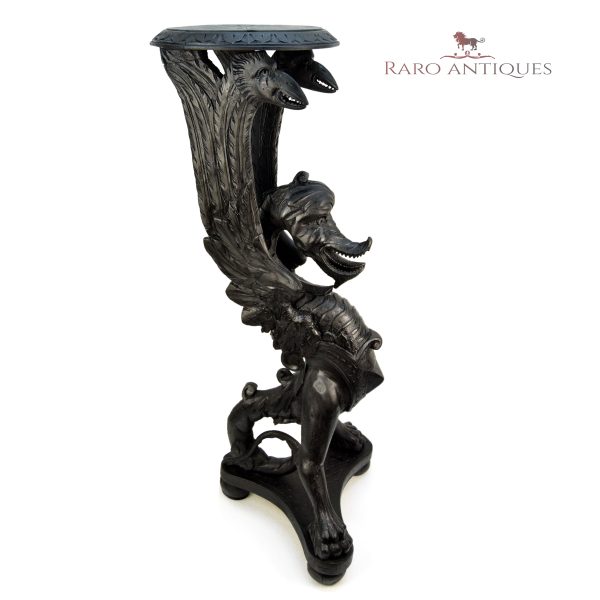
ANTIQUE FLOWER STAND

520,00 

Flower stand, made at the end of the 19th century.

A wooden flower stand adorned with an impressive carved dragon motif, which gives it exceptional artistic value. The intricately designed dragon occupies the central position on the stand, imparting a sense of power and movement with its interwoven details. The dragon serves as a base for a shelf where a flowerpot can stand. Its unique, hand-carved appearance and artistic craftsmanship speak to the mastery of the craft and aesthetic refinement. This stand is not only practical but also a unique work of art, expressing the influence of the exotic aesthetics popular in the 19th century and will complement any environment beautifully. Dimensions: 107 x 50 x 46 cm Weight: 7 kg The flower stand is in excellent condition.
Close

ANTIQUE SALT AND PEPPER SHAKERS

28,00 

Antique salt and pepper shakers from the early 20th century.

Two large glass containers for salt and pepper. Due to their size, they will be an excellent addition to any kitchen. Their appearance also makes them a beautiful centerpiece for the dining table. Dimensions: 13 x 9 cm Weight: 200 g The salt and pepper shakers are in excellent condition. Price is for one.
Close

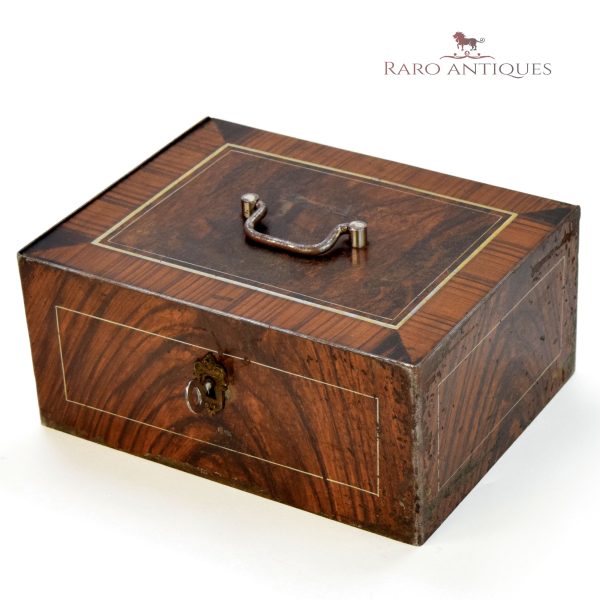
SAFE, CCA. 1900

125,00 

Safe, made in Poland, early 20th century.

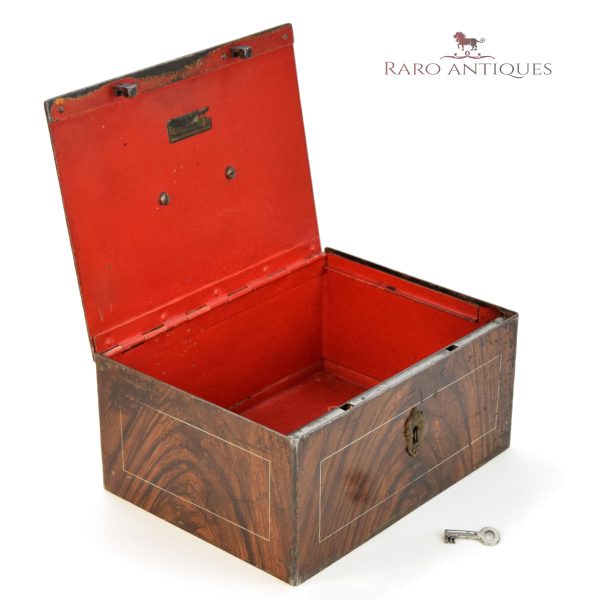
A safe with a faux wood-grain finish, a working lock and key, and a maker's label. Unfortunately, only the place of manufacture, Breslau (present-day Wrocław), can still be identified on the label.

Today, this heavy metal box serves as an excellent decorative piece. Thanks to its functioning lock, it remains suitable for storing valuables and personal belongings.

Dimensions: 29 × 22 × 14 cm

Weight: 4,5 kg

The safe is in good condition.

Close

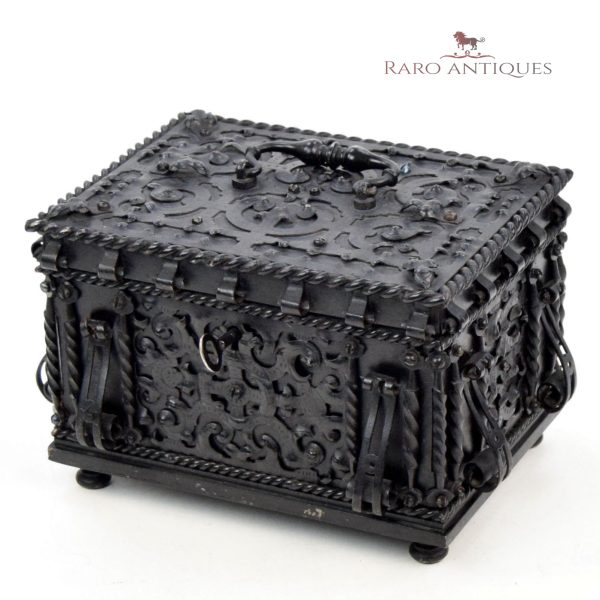
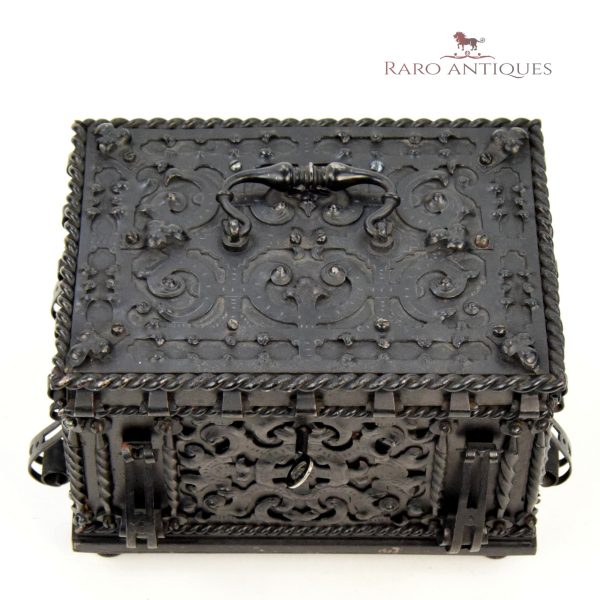
WROUGHT-IRON CASKET

430,00 

Wrought-iron casket, made in the second half of the 19th century.

An exceptional and rare, hand-forged casket in the Neo-Gothic style. It is fully preserved, with a functioning lock and key.

In the past, such a casket would have been part of a bourgeois interior, serving both as a decorative and a practical object used to store important documents, jewelry, and other valuable items. It can serve the same purpose today, as the craftsmanship with which it was made is a true feast for the eyes, and the working lock still allows it to be used for storing valuables.

Dimensions: 25 × 18,5 × 16 cm

Weight: 3,9 kg

The casket is in excellent condition.

Close

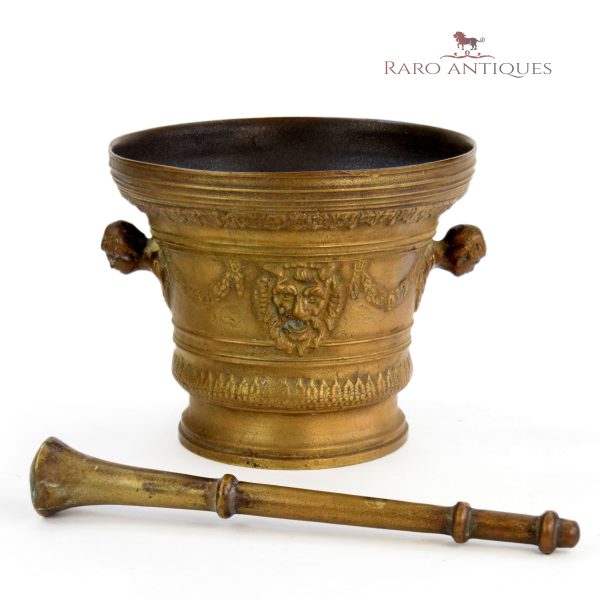
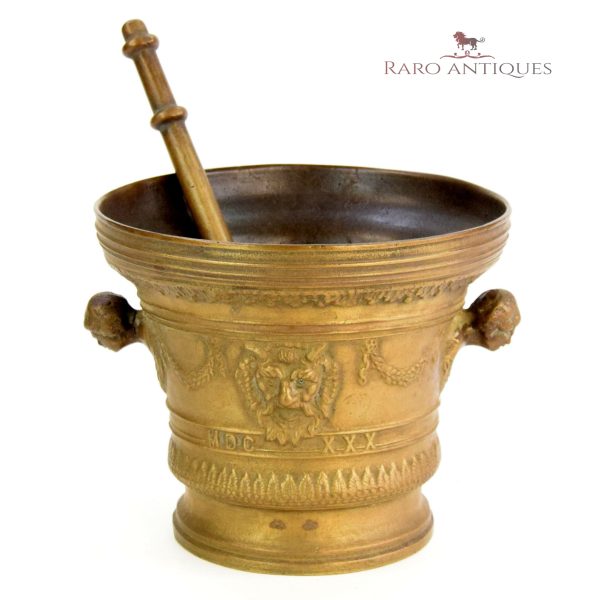
BRASS MORTAR

580,00 

Brass mortar, made in the late 19th century.

A massive mortar that is a replica of 17th-century mortars. Such large mortars were primarily used in the 17th century in pharmacies and monasteries for grinding large quantities of herbs. In the 19th century, these replicas became mainly status symbols in wealthy bourgeois kitchens, although some still found their way into pharmacies.

The presented mortar is richly decorated with relief mascarons, garlands, and the Roman date MDC XXX (1630). It also includes the original matching pestle for grinding, which is likewise heavy and made of brass.

Today, this luxurious mortar can serve as an exceptional decorative and functional piece in your kitchen or professional space.

Dimensions:
25 × 25 × 21 cm – mortar
34 × 5 cm – pestle

Weight: 9,7 kg

The mortar is in excellent condition.

Close

ANTIQUE HAT STAND

80,00 

Antique hat stand from the mid-19th century.

Turned wooden hat stand will be an excellent addition to any wardrobe, as you can keep your favorite headwear on it. Since it was originally made as a display item in millinery, it can find its place there again. Dimensions: 39 x 14 cm Weight: 320 g The hat stand is in good condition.
Close

ANTIQUE TIN BOX

47,00 

Tin box from the late 19th century.

This charming tin box with a colorful floral design is perfect for storing small treasures or keepsakes. In the past, it was likely used as a pencil case due to the convenient small compartments designed for holding pens, while the larger section was likely meant for ink bottles. The box comes with a key and a beautifully functioning lock, ensuring that your stored items remain safe and secure. Dimensions: 18 x 15 x 6 cm Weight: 350 g The box is in excellent condition.
Close

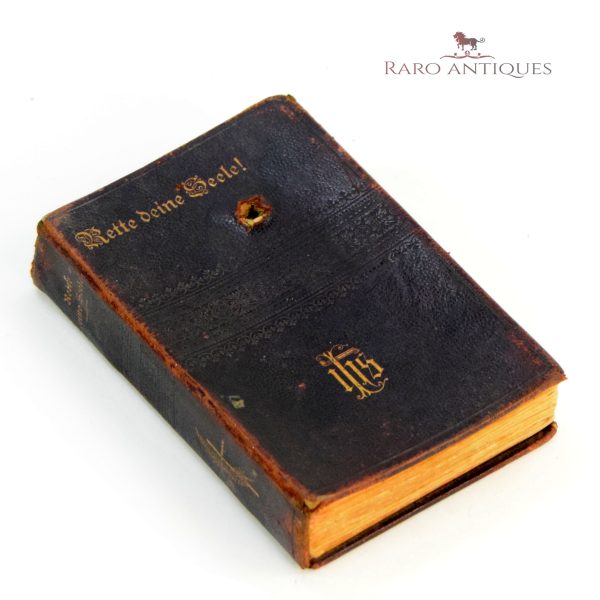
PRAYER BOOK THAT STOPPED A BULLET

375,00 

Prayer book “Rette deine Seele!” (Save Your Soul), Klagenfurt, 1898.

At first glance, this small pocket prayer book appears to be just an old devotional volume – yet hidden within its leather cover lies a bullet hole that pierced almost the entire book, silently speaking of its remarkable history and most likely of a miracle it once created.

If we turn back more than a century, to the time of World War I, such books – especially Bibles and prayer books – were often given by families to soldiers departing for war. They were gifted as spiritual protection and as a reminder of home. It is now well known that soldiers themselves also wished to keep such books close, believing they could shield them from death. For that reason, these volumes were frequently carried in inner breast pockets, as lucky charms. The presented prayer book is almost certainly one of those rare examples of faith and fortune intertwined, a witness to the small miracles these books once worked in the midst of war.

This prayer book stands as a striking symbol of survival, and because of its history and the story it carries, it represents an exceptional historical artifact.

Dimensions: 14 × 9 × 3 cm

Weight: 0,15 kg

The prayer book is well preserved.
Close

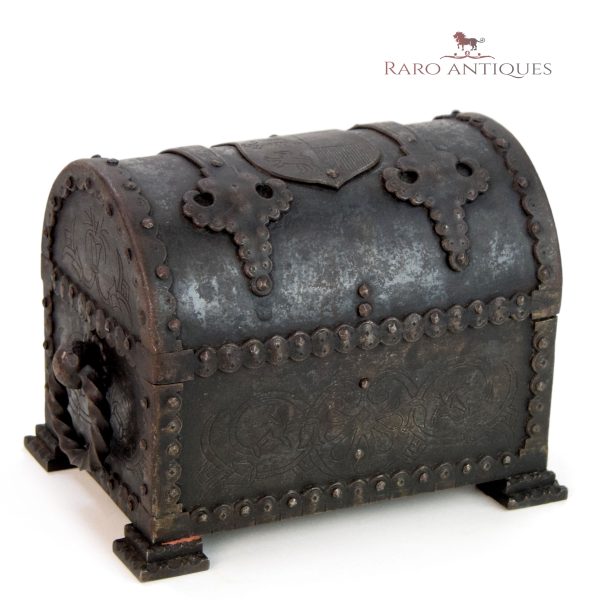
METAL CASKET

140,00 

Metal casket with the Carinthian coat of arms, made in the early 20th century.

An exceptionally well-crafted piece with beautiful detailing. The Carinthian coat of arms on the lid makes it particularly interesting. On the front of the casket there is a small “button” that allows it to be opened.

Dimensions: 20 × 15,5 × 14 cm

Weight: 2,3 kg

The casket is in excellent condition.

Close

SCOLD’S BRIDLE

820,00 

The scold's bridle.

The scold's bridle or brank, originating from Scotland in the 16th century, was a horrific device designed to cause shame, discomfort, and pain to its wearer. Its usage spread from Scotland to England, Germany, and other European countries. Its purpose was to shame, silence, and physically discomfort individuals who were deemed unruly or outspoken, particularly women who challenged authority or societal norms. Often, these bridles were crafted to resemble masks with distorted facial features, such as large ears, noses, or horns. Some even had bells attached to them, further humiliating the wearer and drawing attention to their presence. The bridle, worn for a minimum of several hours, prevented its wearer from eating, drinking, and most importantly, speaking. It consisted of a metal part inserted into the mouth, similar to a bit in a horse's harness, which held the tongue in place. In more severe cases, these metal mouthpieces had spikes, causing additional pain. The bridle was predominantly used as a punishment for women who were considered too vocal or contentious in public, especially widows or older women who were not under male control. It was also known as a "witch's bridle," indicating its use during witch trials to prevent accused witches from casting spells on their captors or communities. Additionally, disobedient wives could be subjected to this punishment at their husbands' request. While men could also face this punishment if perceived as a threat to the common good, it was primarily reserved for women deemed gossips, adulterers, prostitutes, or witches, as well as those who defied societal norms. The bridle served as a stark reminder of the oppression women faced and the consequences of expressing dissent in conservative societies. Remarkably, this punishment was not abolished in England until 1967, reflecting the enduring legacy of patriarchal control and the gradual progress towards women's rights. The scold's bridle serves as a poignant relic of the past, prompting reflection on the darker aspects of human history. Dimensions: 26 x 25.5 x 21 cm Weight: 3.2 kg The scold's bridle is in excellent condition, complete with a lock and accompanying key.
Close

ANTIQUE MECHANICAL BANK

320,00 

Mechanical bank, 1896, made by J.E. Stevens Company, USA.

An intriguing hand-painted cast iron mechanical bank that operates using a simple hand mechanism. The design allows you to place a coin in the figure’s palm. When you press the lever, the mechanism moves the coin up to the figure's mouth, retracts the tongue, winks, and the coin is "eaten." These mechanical banks are highly sought-after collectibles, combining a playful function with decorative appeal. The J.E. Stevens Company, founded in Connecticut, gained fame for producing a variety of cast iron mechanical banks. Their banks are highly valued for their durability, innovative mechanisms, and distinctive designs. Dimensions: 21 x 17 x 14 cm Weight: 2.4 kg The bank is in good condition.
Close

ANTIQUE BABY CARRIAGE

260,00 

Vintage baby carriage from 1910, made in Germany by Brennabor.

A nostalgic piece of the past, this vintage baby carriage can now serve as an interesting decoration in your home or office space. Suitable for planting flowers in it, it is already highly decorative and will be a nostalgic addition that brings history into your living space. Dimensions: 110 x 96 x 54 cm Weight: 15 kg The baby carriage is well-preserved.
Close

ART NOUVEAU TEA SET

145,00 

Tea set, made in the early 20th century.

The set includes a teapot, a sugar bowl, and a milk/cream jug. The marks found on the underside of the vessels indicate that the set is silver-plated. Due to age, the silver plating has developed a beautiful patina, which is an important part of the character and authenticity of such pieces. Today, this set is ready to become a wonderful decorative accent in your kitchen, while still being perfectly suitable for hosting an unforgettable tea party and impressing your guests.

Dimensions:
Teapot: 22 × 15 × 13 cm
Sugar bowl: 13 × 9 × 9 cm
Milk jug: 13 × 10 × 7 cm

Weight: 1 kg (entire set)

The set is in excellent condition.

Close

PRAYER BOOK “HEAVENLY GATE”, CCA. 1880

65,00 

German prayer book from the late 19th century.

A small devotional prayer book bound in richly embossed leather, decorated with a celluloid cross and gilded ornamental details. The book is complemented by its original metal clasp, brass-mounted cover edges, and gilt page edges, all characteristic of high-quality Victorian-era Catholic prayer books.

Inside, there is a handwritten dedication dated 1888, giving the piece a particularly personal and historical character. The book bears ecclesiastical approval dated 1881.

An exceptional collector’s and decorative piece with a strong devotional aesthetic, suitable for collectors of religious antiques and Victorian objects.

Dimensions: 14 × 10 × 3,5 cm

Weight: 0,3 kg

The prayer book is in good condition.

Close

SPICE BOX

170,00 

Spice box from early 19th century, from India.

An intriguing spice box made from a single piece of wood, featuring a side-opening lid secured with a hand-forged latch. Such boxes (masaladabbis) are artistic objects passed down through generations within families. A beautiful piece that can still be used for its original purpose or to store other small items. Its excellent craftsmanship and unique appearance also make it an outstanding decorative piece. Dimensions: 34 x 15.5 x 10 cm Weight: 1.3 kg The box is excellently preserved.
Close

SAFE

85,00 

Safe, manufactured in the mid-20th century.

The safe is made entirely of metal, making it solid and heavy. It features a working lock with a key, meaning it can still be used to store money and valuables. Inside, it also has an additional compartment for easier organization of documents or cash.

The red paint is now beautifully worn, giving the safe a charming, characterful patina.

Ideal for storing your treasures, while also serving as a decorative piece with an industrial touch.

Dimensions: 18,5 x 14,5 x 7,5 cm

Weight: 2,5 kg

The safe is in good condition.

Close

MARLBORO ADVERTISING FIGURINE

160,00 

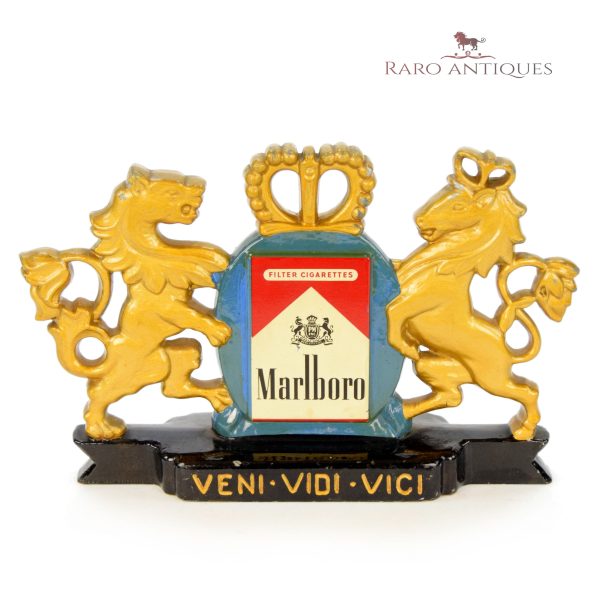
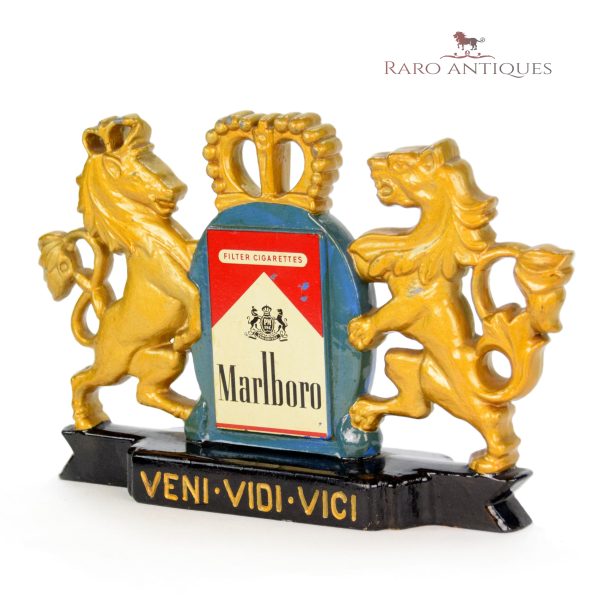
Marlboro advertising figurine from the 1950s.

An extremely rare, double-sided Marlboro advertising figurine. The figurine is made of metal and represents the emblem of the Philip Morris brand – a lion, a horse, and a crown, which also adorn the classic Marlboro cigarette packs. At the center is a realistic depiction of a Marlboro pack in its recognizable red and white tones, while the base features the Latin inscription "Veni, Vedi, Vici" (I came, I saw, I conquered).

This unique collectible piece is perfect for vintage advertising enthusiasts, tobacco memorabilia collectors, and as a remarkable decorative item with historical value.

Dimensions: 26 x 16,5 x 6 cm

Weight: 2,8 kg

The advertising figurine is in excellent condition.

Close

MID-CENTURY MAGAZINE STAND

140,00 

Magazine stand, made in France, mid-20th century.

An interesting magazine stand made of metal and glass. On each side of the stand, behind glass, there is a framed lithograph. One lithograph depicts “Voiture de la cour” – a court carriage, while the other shows “Diligence de ville” – a city carriage. The stand also features an intriguing mechanism that allows it to open or close by pulling the handle.

Dimensions: 62 x 46 x 23 cm

Weight: 5,1 kg

The stand is in excellent condition.

Close

ITALIAN NYLON STOCKINGS GI. LO. DE, 1950s

85,00 

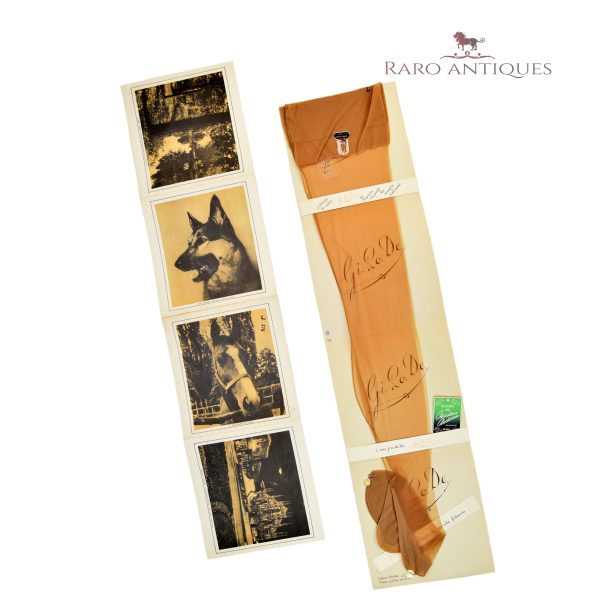
Gi. Lo. De Nylon Stockings, made in Italy in the early 1950s.

A rare and exceptionally preserved factory sample set by the Italian brand Gi.Lo.De, dating to around 1950–1951.
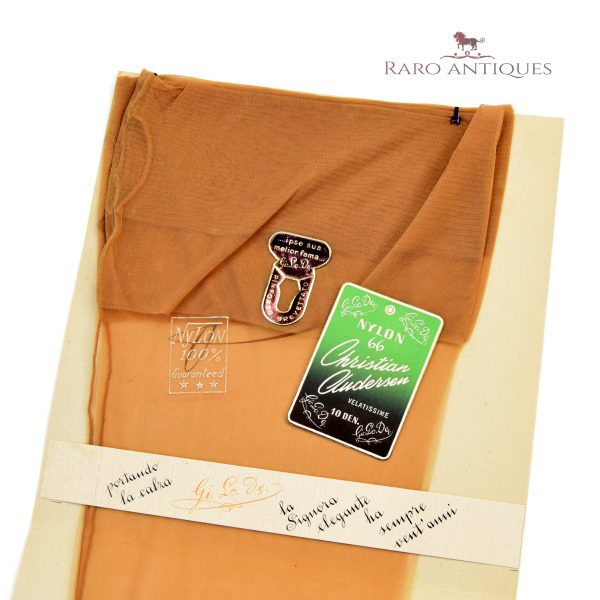
The set includes a pair of never-worn, ultra-sheer nylon stockings with a back seam, attached to the original presentation card featuring four sepia-toned photographs (Duomo, horse, dog, and landscape), along with factory labels and pins.

This is a typical post-war display sample, where luxury nylon stockings were presented with artistic packaging — a reflection of their status as a luxury item at the time.
The green “Nylon 66” card also confirms the use of the first generation of DuPont nylon, which makes this piece particularly special.

An exquisite find for vintage fashion lovers, and a museum-worthy collectible for connoisseurs of mid-century design.

Dimensions: 91 × 22 × 0,5 cm

Weight: 0,01 kg

The stockings are in excellent preserved condition. Price per pair.

Close

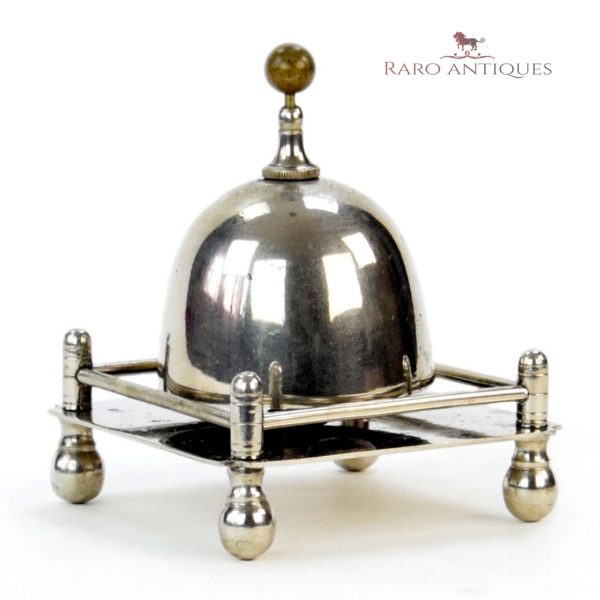
TABLE BELL, CCA. 1905

135,00 

Desk bell, made in the early 20th century in Berlin

A chrome-plated desk bell that rings when the top button is pressed. It was most likely used in establishments such as hotels or shops, where customers could ring it to attract attention.

Historically, desk bells were primarily used in aristocratic households. During long meals, they were used to summon a maid to serve the next course or bring drinks. This custom was particularly widespread in America, whereas in Europe it was more common for servants to stand by the table so they could immediately attend to any request. Desk bells became widely used in Europe only in the 19th century, when they started to appear in establishments such as hotels, restaurants, and shops.

Dimensions: 11,5 × 9,5 × 9,5 cm

Weight: 0,4 kg

The bell is in excellent condition.

Close

ANTIQUE ICE BUCKET

1.800,00 

Ice bucket, from the 1913.

An exceptional ice bucket, commemorating the 30th anniversary of the Milanese gymnastics club Pro Patria, as engraved on the bucket itself. The ice bucket displays all the marks of top-tier craftsmanship. Its most beautiful details are undoubtedly the intricately crafted elephants, along with the festive garland encircling the bucket, further emphasizing its luxurious design. This exquisite piece serves both as a decorative and functional item, ideal for chilling champagne during special occasions. Its beauty ensures it will also find a prominent place on your shelf, where you can admire it daily. Dimensions: 46 x 38 x 22 cm Weight: 2.8 kg The ice bucket is in good condition.
Close

ANTIQUE TEAPOT

115,00 

Teapot, from 1911.

A silver-plated teapot with a milk jug can be a wonderful decoration on your kitchen shelves, and of course, you can still use it to make an unforgettable tea party. Dimensions: 28.5 x 15 x 13.5 cm Weight: 550 g The teapot is well-preserved.
Close

ANTIQUE COSTREL

230,00 

Costrel, made in the 19th century.

A costrel, or hand barrel, was used for storing liquids, primarily wine. It is made of treated oak planks, bound together with hand-forged iron hoops. The costrel is in its original condition and has a beautiful patina that reflects its age. This is, in fact, a piece of cultural history, a reminder of the traditions and ways of life of past centuries. An exceptional item for collectors and history enthusiasts. Dimensions: 27 x 20 x 15 cm Weight: 1 kg The costrel is in good condition.