
The spaces in which we spend the most time reflect our style, our taste, and in a way, our personality. We can make a space our own with small details that reflect our desires and interests. This is most easily achieved with decorative objects. We are confident that you will find the piece here that represents you, inspires you, and transforms the space into your home.


ANTIQUE TABLE MIRROR
Antique table mirror from the early 1900s.
A table mirror that will be a beautiful timeless piece on your vanity or shelf. It is extremely decorative, and because of the patinated mirror, it is especially charming. The mirror is not just a beautiful decoration for the wall, but it is a key element in the home. Think about it, we have them in hallways, by entrance doors, in bedrooms, and last but not least, in bathrooms as a tool for personal grooming, but mirrors can also be wonderful light transmitters, so we can place them on tables in rooms where we don't usually need them, visually enhancing the room and adding some light. With old mirrors, which also feature a beautiful patina, we bring uniqueness into our home, which will inspire you for years to come. Dimensions: 26 x 14 x 9 cm Weight: 1.5 kg The mirror is in excellent condition, and the glass is patinated.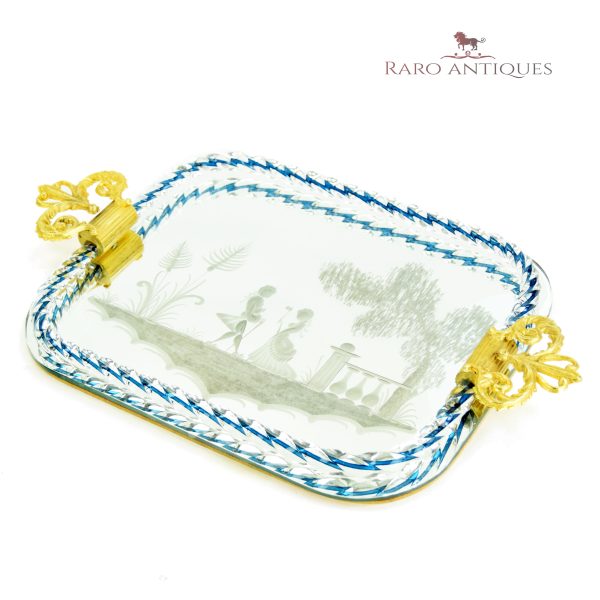

TRAY BAROVIER
Tray crafted in the 1940s, from the hands of master Murano glass designer Ercole Barovier.
This tray was made in Italy at the Barovier glassworks, one of the oldest operating companies. Its design was signed by Ercole Barovier, who devoted all his attention to exceptional details. The mirror representing the bottom of the tray is engraved with a romantic landscape featuring a couple, while the edge of the tray is adorned with glass in transparent and dark blue colors. The tray handles are brass and gilded. Every detail, when examined closely, reveals exceptional precision in craftsmanship, reflecting the mastery of the artisan who dedicated his life to them. An excellent addition to any home. Place it on the table as an exceptional decorative piece, and use it to serve drinks and snacks to impress your guests. Dimensions: 45 x 28 x 4 cm Weight: 2.2 kg The tray is in excellent condition.

ANTIQUE TABLE MIRROR
Table mirror, 1940s, made in Italy.
A charming brass mirror adorned with delightful details. The design features cherubs, floral motifs, and a pair of lovers targeted by Cupid's arrow. The mirror stand also includes a convenient recessed dish, perfect for holding jewelry or small items. This mirror is not just a beautiful decorative piece but also an essential element in any home. Mirrors are found in hallways, near entry doors, bedrooms, and bathrooms as practical tools for personal grooming. However, mirrors can also serve as stunning light reflectors. Placing them in rooms where they aren't traditionally needed can visually enhance the space and add brightness. Antique mirrors, with their lovely patina, bring a unique character to your home and will continue to inspire you for years. Dimensions: 41.5 x 25.5 x 11 cm Weight: 2.4 kg The table mirror is in excellent condition. The brass frame and original patinated mirror glass are intact.

JUGENDSTIL BOWL
Decorative bowl from the early 20th century.
The bowl features a metal base and a crystal glass dish, designed in elegant, classical proportions. It is suitable for placement on a table, sideboard, or in a display case, where it can be used to hold fruit, biscuits, or other small items.
Dimensions: 21 × 20,5 cm
Weight: 0,6 kg
Bowl is in excellent condition.


ANTIQUE BUST SCULPTURE
Antique bust sculpture, created in 1906, by Italian sculptor Emilio Marsili.
The bust sculpture of an elderly man will be an intriguing addition to your home or institution. You can hang it on the wall or place it on a shelf/table. The sculpture has been evaluated by the museum in Rome, ensuring that you'll be bringing top-notch art from the previous century into your spaces. This offers you an excellent opportunity to own a piece by the esteemed sculptor, whose works are otherwise displayed in museums. Emilio Marsili was born in Venice in 1841. He trained as a sculptor at the Venetian Academy under L. Ferrari, then moved to Paris, where his Venetian education flourished, making him extremely popular. After Paris, he moved to Belgium, inspired by the sculptors there. However, homesickness drew him back to Venice, where he continued to dedicate himself to his craft. During that time, he contributed to the remodeling of Palazze Cavalli Franchetti, created a bust sculpture of Vittorio Emanuele II for the town hall in Pordenone, and crafted a relief for the facade of the Pietà church in Venice, which can still be found there today. In those years, he also received his first recognitions for his work, not only in his native Italy but also receiving awards in Vienna and Paris, with museums beginning to acquire his works. He was described as an "aristocratic artist" endowed with "an instinctive sense of measure, allowing him to be lively without being vulgar and strict without being harsh." In later years, he became known primarily for crafting prestigious tombstones, including one for Queen Margherita of Savoy. He passed away in 1926 in Venice, and his works remain part of museums today, highlighting his enduring creative energy, which is still appreciated to this day. Dimensions: 68 x 65 x 40 cm Weight: 12 kg The bust sculpture is well-preserved and signed.

SPRING-LOADED CANDLE HOLDER DITMAR
Spring-loaded candle holder made by the Ditmar company, produced between 1895 and 1907.
A rare example of a perfectly preserved spring-loaded candle holder. The candle holder, with its spring, allows you to adjust the height of the candle so that, regardless of the candle's length, it always stays at the same height. An interesting addition to a festive table or a shelf where you can always admire it. Karl Rudolf Ditmar, the founder of the Ditmar company, was born on May 3, 1818, in Prenzlau - Brandenburg. He came to Vienna in 1839. During a business trip to Paris, he is said to have encountered the still-controversial, heavy-working moderator lamp. Improving these lamps soon became his main concern. On August 5, 1840, Ditmar founded a trading company dealing with oil lamps, cups, and lacquered tin. The next step was establishing a workshop for lamp repairs, followed by an attempt at in-house production. Together with his brother Friedrich, whom he invited to Vienna, Rudolf led the company as "Gebrüder Ditmar" in 1841. For this purpose, a "state permit for the production of lacquered tin and zinc composite goods" was issued, creating a legal basis for the first lamp factory in Vienna and Austria. During this time, the brothers succeeded in developing the "Viennese moderator lamp," a spring-loaded lamp that was both inexpensive and reliable due to its adjustable oil supply. After the death of his brother Friedrich in 1858, "Gebrüder" was removed from the company's name, and it became Lampen Fabrik R. Ditmar. Even after his death in 1895, the company retained his name and tradition. Dimensions: 41 x 11.5 cm Weight: 510 g The spring-loaded candle holder is in excellent condition.

JESUS IN EBONY
Jesus Christ in Ebony, created in the mid-20th century
A hand-carved depiction of Jesus Christ, made entirely from solid ebony, executed in the characteristic style of the Makonde carving tradition of East Africa. The sculpture is defined by an ascetic facial expression that reflects an African approach to the sacred figure—symbolic, restrained, and inward rather than dramatic. The absence of the cross and explicit signs of martyrdom points to an inculturated Christian iconography, in which Christ is presented as a universal spiritual figure expressed through a local visual language.
The choice of material is particularly noteworthy: ebony holds strong symbolic significance in many African cultures and is also exceptionally difficult to work, indicating the hand of an experienced and skilled carver.
This representation of Christ is therefore an excellent collector’s and decorative piece, combining Christian iconography with one of the most important carving traditions of sub-Saharan Africa, and carrying a strong cultural and spiritual presence.
Dimensions: 35 × 30 × 5 cm
Weight: 0.4 kg
Statue is in excellent condition


ANTIQUE ALTAR
Altar from the first half of the 20th century.
Wooden altar with a crucifix, two candle holders, and a holy water font. Such home altars were once an essential addition to every household, but nowadays, home altars are very rarely encountered. Dimensions: 29 x 19.5 x 11 cm Weight: 450 g The altar is in excellent condition.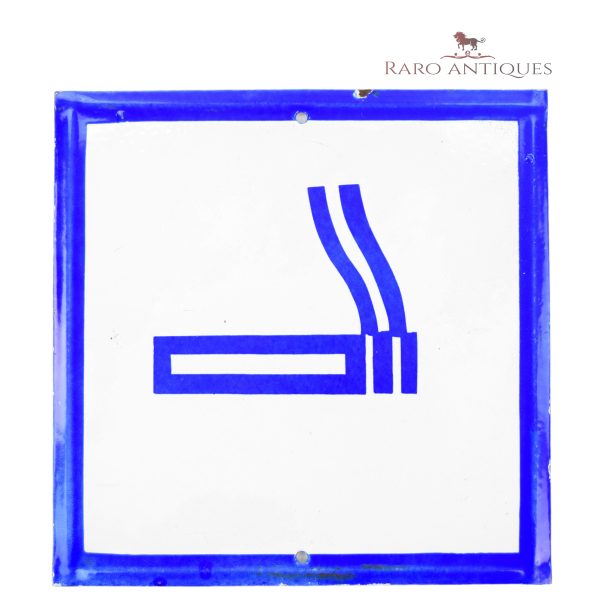

ENAMEL SIGN
Enamel sign, from the 1970s.
Blue and white enamel sign indicating a designated smoking area. An interesting industrial decorative accent.
Dimensions: 30 × 30 × 0,5 cm
Weight: 1 kg
The sign is in excellent condition.


VINTAGE CANDLESTICK
Candlestick from the 1970s, marked with J. Gallo patentiert.
Candlesticks are a welcome decoration in any home. Whether they illuminate a festive dinner in the dining room or create a romantic atmosphere in the bedroom, candlesticks are undoubtedly one of those items that come in handy on any occasion. Dimensions: 13.5 x 6 cm Weight: 300 g The candlesticks are in excellent condition. Price is for one.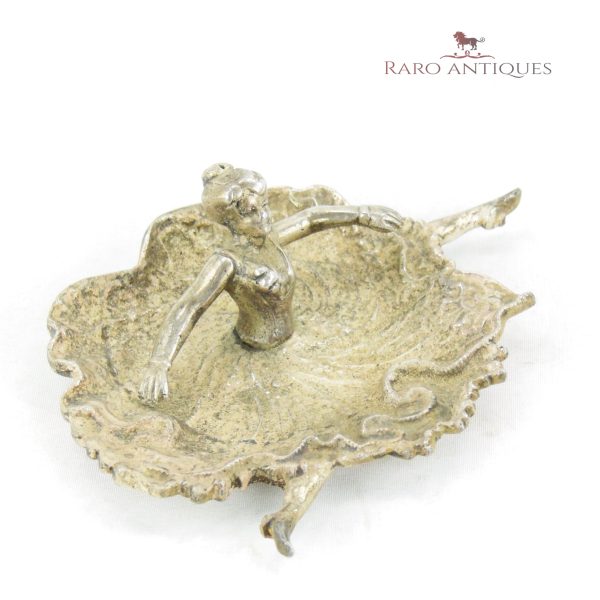
ANTIQUE VISITING CARD TRAY
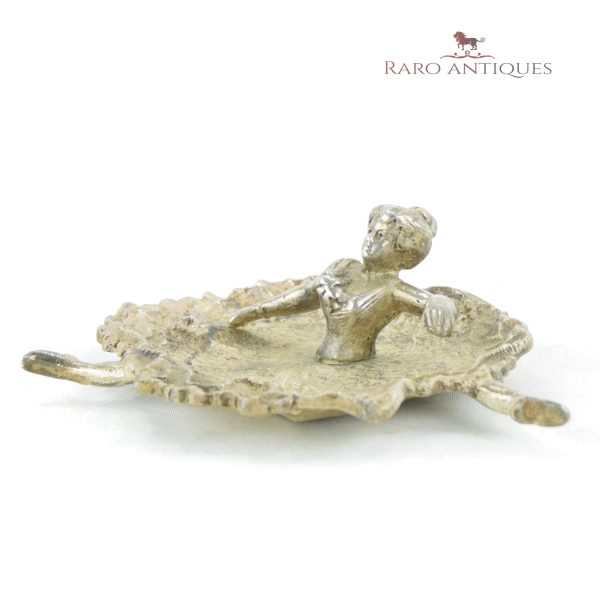
Antique visiting card tray from the Art Nouveau period.
This tray is designed for visiting cards, which were used in the 19th century as a kind of vintage social network. You can read more about it here: https://raroantiques.com/socialno-omrezje-viktorijanske-dobe Featuring an image of a dancer, this tray is sure to catch the eye as a beautiful decorative piece. You can place it on your office desk and use it for business cards or display it in the hallway, where it once belonged. Dimensions: 15.5 x 13 x 6 cm Weight: 0.4 kg The visiting card tray is well-preserved.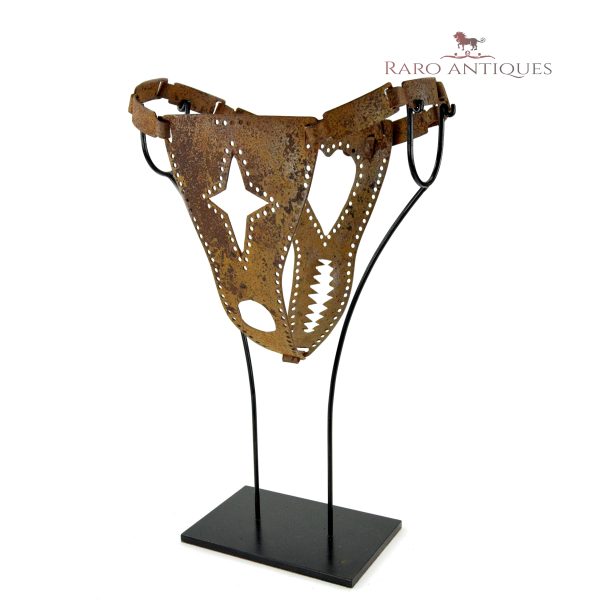
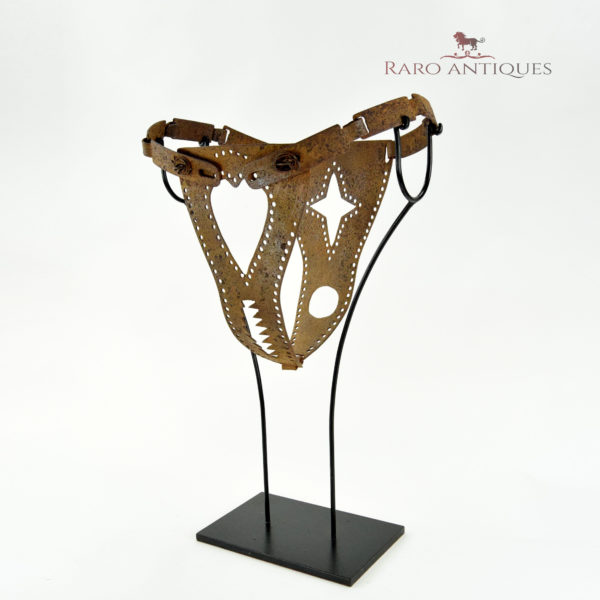
CHASTITY BELT
The chastity belt.
Who hasn't heard of the chastity belt? A device that supposedly helped husbands and fathers ensure that their wives and daughters remained untouched and "pure" as far back as the Middle Ages. This was said to be a metal belt tightened around a woman's waist, locked by the man with a large padlock. This medieval man could then be free of worries that his chosen one would engage in sexual relations with someone else, despite their prolonged absence due to wars. How barbaric and unhygienic, isn't it? At least that's the story that has been told for centuries. Simple, shocking, and somewhat amusing, as it portrays past people as extremely backward, contrasting with our enlightened and better selves. However, this is not the true story of the chastity belt. The truth is, there is no physical evidence that chastity belts existed in those times, at least not in a physical form. They are mentioned a few times in literature and depicted in artworks, albeit more in an allegorical and satirical sense. The earliest evidence of a chastity belt can be found in a book by military engineer von Eichstadt from 1405, which described catapults, armor, and torture devices, including a sketch of a chastity belt. Historians are convinced that this was just one of the humorous inventions he included in the book, similar to a device for becoming invisible or a fart-propelled contraption, which further solidifies the fact that chastity belts were not used in the Middle Ages. The surviving examples of chastity belts found today are believed to have been made in the 19th century. With the advent of industrialization in Europe, materials such as iron and steel became more accessible, and soon blacksmiths realized there was a particular market they could tap into. Puritanical masses of that time were willing to pay a lot of money to view medieval torture devices in museums and exhibitions, satisfying their craving for their own judgment of medieval barbarism. Thus, blacksmiths of that time made several torture devices, including chastity belts, and sold them to museums and collections. Interestingly, the chastity belt probably was never in widespread use in the past, but its use has spread precisely in modern times, in BDSM and fetish communities. Thus, the chastity belt is an urban legend of the Middle Ages that has survived to this day. Now it can be an interesting addition to any historical collection or a fascinating ornament to spark debates. Certainly, one of those pieces that tell a story and stimulate our imagination. Dimensions: 55 x 35 x 25 cm Weight: 4 kg The chastity belt is in excellent condition.
VENETIAN HAND MIRROR
Venetian Hand Mirror from the 1930s.
A wooden and gilded mirror that will be excellent for many ladies to quickly glance at themselves and tidy up. It can also serve as a decorative piece on a shelf, table, or mounted on the wall. Dimensions: 32 x 14.5 cm Weight: 110 g The hand mirror is in excellent condition.

ANTIQUE CANDLESTICK
Antique candlestick from the 1870s.
These exceptional candlesticks are richly patinated and luxuriously adorned. Candlesticks are a welcome ornament in any home. They can be placed in the dining room to illuminate a festive dinner, or in the bedroom to create a romantic atmosphere. However they are used, candlesticks are certainly one of those items that come in handy for every occasion. Dimensions: 35 x 15 cm Weight: 1.5 kg The candlesticks are well-preserved. Price is for one.

G. MORETTI – “RAMON”
A bronze bust created by Giuseppe Moretti in the early 20th century.
An outstanding work by the Italian sculptor Giuseppe Moretti, titled Ramon.
This bronze bust reflects Moretti’s characteristic style, in which he united late Realism with early Modernism and used portrait sculpture to explore the inner psychological state of his subjects. Today, this museum-quality piece can become part of your collection and will undoubtedly draw attention through its strong presence and impressive scale.
Giuseppe Moretti (1857–1935) was an Italian sculptor born in Siena who spent most of his career in the United States. He was educated in Italy and later worked in Zagreb before emigrating to the U.S. in the 1880s, where he became known for monumental public sculptures as well as deeply psychological portrait and figurative bronzes. He is still recognized today as the author of numerous large-scale monuments across the United States and highly ambitious smaller portrait busts such as the present work. Before his death, he returned to Italy and spent his final years in San Remo, where he passed away.
Dimensions: 47 × 36 × 34 cm
Weight: 22,8 kg
The bust is in excellent condition.

CANDLESTICK


ANTIQUE COLONIAL FIGURINE
Portuguese colonial figurine, late 1600s.
An interesting and beautifully patinated wooden figurine, whose depiction remains unidentified. The base was added in later years to provide stability to the figurine. Dimensions: 13.5 x 8 x 5 cm Weight: 0.1 kg The figurine is well preserved.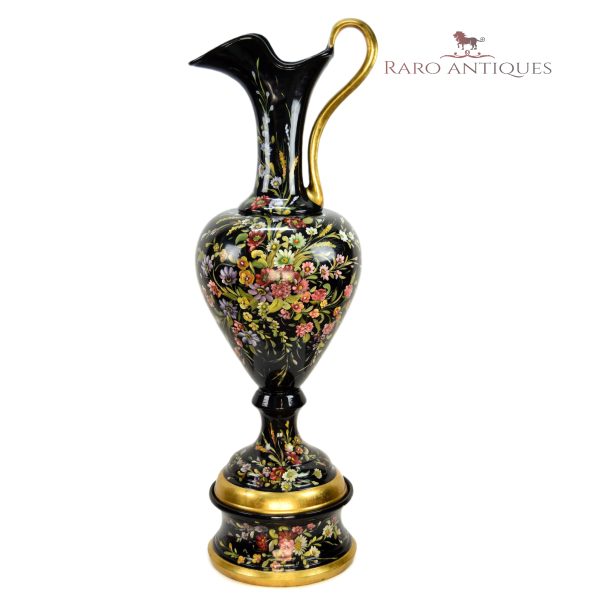
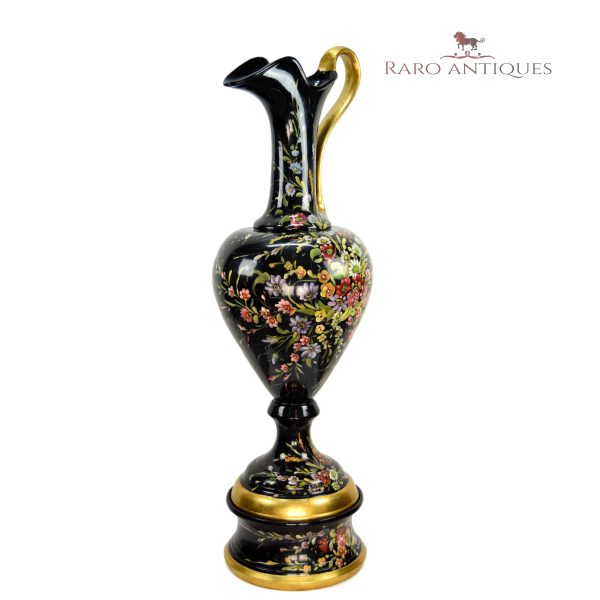
VINTAGE LARGE VASE
Large vase, made in Italy by Tellatin in the 1950s.
This highly decorative large vase with a pedestal, hand-painted with floral motifs, showcases extraordinary craftsmanship. Creating such sizable ceramic pieces requires exceptional skill and precision, as they are incredibly delicate in the initial stages of production. An outstanding piece, this vase is perfect for decorating both indoor and outdoor spaces, whether in a home or professional setting. It will enrich and elevate any area where it is displayed. Dimensions: 120 x 40 x 36 cm Weight: 13 kg The vase with the pedestal is in excellent condition.

LA BARGE MIRROR
Mirror made in the mid-20th century by La Barge.
The mirror features a richly decorated, gilded frame with hand-painted floral details that give it a refined and elegant appearance. It was produced by the prestigious company La Barge, known for its high-quality craftsmanship — a standard clearly reflected in this piece as well.
Dimensions: 121,5 x 64,5 x 5 cm
Weight: 4,4 kg
The mirror is in excellent condition.
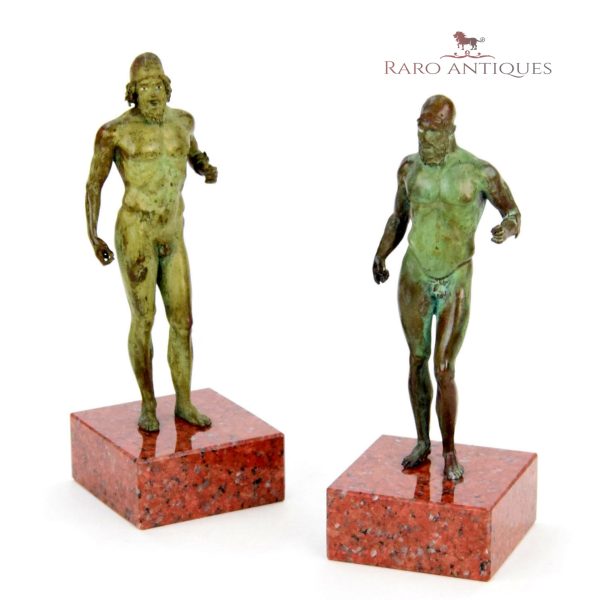
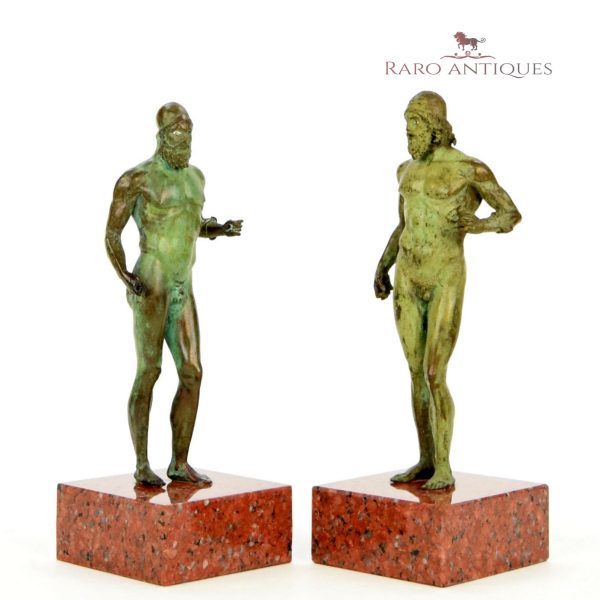
RIACE WARRIORS
Replica of the Riace Warriors, made in the second half of the 20th century.
The statuettes represent replicas of the famous ancient Greek bronze sculptures dating from the mid-5th century BC, which were discovered by divers in 1972 in the sea near the town of Riace in southern Italy. The originals depict two athletic nude figures of ancient Greek heroes and are considered among the most important discoveries of Greek sculpture. Today, the original bronze statues are exhibited at the Museo Nazionale della Magna Grecia in Calabria, where they are preserved as a valuable treasure of ancient art. Owing to their exceptional aesthetics and historical significance, they are regarded as iconic works of art.
The presented replicas are also cast in bronze and mounted on marble bases.
Dimensions: 24 × 9 × 9 cm
Weight: 1,4 kg each
The statuettes are in excellent condition. Price for the pair.


ANTIQUE JEWELRY BOX
Bronze jewelry box, late 19th century, Hungary.
This exquisite gilded bronze jewelry box is a true masterpiece of craftsmanship. Its surface features remarkably detailed reliefs, depicting lively scenes of medieval people dancing, drinking, and celebrating. Every detail, from the delicate expressions on the faces to the intricate movements of hands and feet, breathes life and dynamism into the scenes. The patina developed over the years adds even more charm to this extraordinary piece. Far more than just a functional jewelry box for storing necklaces, rings, and other small treasures, this is a window into the past. Its striking aesthetics are sure to captivate any observer, inspiring admiration and a sense of history. It’s not just a beautiful decoration but a tangible link to history, adding a touch of elegance and storytelling to any space where it is displayed. Dimensions: 25.5 x 9.5 x 7 cm Weight: 0.6 kg The jewelry box is in excellent condition.

GIOVANNI VARLESE, STATUE OF A FISHERMAN
A fisherman sculpture, made in the early 20th century.
This metal sculpture on a marble base depicts a young boy fishing. It was created by the Italian sculptor Giovanni Varlese (1888–1922), as confirmed by the signature on the piece.
Dimensions: 38 × 20 × 13 cm
Weight: 2,8 kg
The sculpture is in good condition.

CANDLESTICK
Brass candlestick, manufactured in the 20th century.
Candlesticks are a welcome decoration in any home. Whether placed in the dining room to illuminate a festive dinner or in the bedroom to create a romantic atmosphere, candlesticks are undoubtedly one of those items that come in handy on every occasion. Dimensions: 23 x 15.5 cm Weight: 660 g The candlestick is in good condition.
