BAROQUE STATUE OF JESUS
Baroque statue of Jesus.
Wooden polychrome sculpture of the dead Jesus Christ, from the Baroque period. An exceptional statue depicting Jesus after the crucifixion. Such statues are typically displayed in churches, in large showcases, during Holy Week. Dimensions: 94 x 18.5 cm Weight: 4.1 kg The statue of Jesus Christ is well-preserved.

ANTIQUE MIRROR
Mirror, from the late 18th century.
Mirror, in a wooden gilded and green-painted frame, is a true masterpiece. It is hand-carved and features interesting details, especially the crown of the frame, which showcases the craftsmanship of the artisan who created it. The mirror is original, and since mirrors of that time were made with mercury, it has developed an excellent patina over the centuries, a picture that only time can create. The entire piece exudes historical value and aesthetic appeal, making it ideal for any collection, and it is perfect for enriching the home. It is a true work of art that brings a touch of past luxury and elegance to any space where it is displayed. Dimensions: 62 x 42 x 8.5 cm Weight: 1.8 kg The mirror is well-preserved.

SCOLD’S BRIDLE
The scold's bridle.
The scold's bridle or brank, originating from Scotland in the 16th century, was a horrific device designed to cause shame, discomfort, and pain to its wearer. Its usage spread from Scotland to England, Germany, and other European countries. Its purpose was to shame, silence, and physically discomfort individuals who were deemed unruly or outspoken, particularly women who challenged authority or societal norms. Often, these bridles were crafted to resemble masks with distorted facial features, such as large ears, noses, or horns. Some even had bells attached to them, further humiliating the wearer and drawing attention to their presence. The bridle, worn for a minimum of several hours, prevented its wearer from eating, drinking, and most importantly, speaking. It consisted of a metal part inserted into the mouth, similar to a bit in a horse's harness, which held the tongue in place. In more severe cases, these metal mouthpieces had spikes, causing additional pain. The bridle was predominantly used as a punishment for women who were considered too vocal or contentious in public, especially widows or older women who were not under male control. It was also known as a "witch's bridle," indicating its use during witch trials to prevent accused witches from casting spells on their captors or communities. Additionally, disobedient wives could be subjected to this punishment at their husbands' request. While men could also face this punishment if perceived as a threat to the common good, it was primarily reserved for women deemed gossips, adulterers, prostitutes, or witches, as well as those who defied societal norms. The bridle served as a stark reminder of the oppression women faced and the consequences of expressing dissent in conservative societies. Remarkably, this punishment was not abolished in England until 1967, reflecting the enduring legacy of patriarchal control and the gradual progress towards women's rights. The scold's bridle serves as a poignant relic of the past, prompting reflection on the darker aspects of human history. Dimensions: 26 x 25.5 x 21 cm Weight: 3.2 kg The scold's bridle is in excellent condition, complete with a lock and accompanying key.

LARGE POLYCHROME TERRACOTTA SCULPTURE, ITALY, CCA. 1900
Large polychrome terracotta sculpture, made in Italy, circa 1900.
This unusually large terracotta sculpture immediately evokes the seaside, masterfully depicting two boys caught in a moment of carefree play. The composition feels light and full of life, while the modeling of the figures is exceptionally convincing: the bodies are naturally formed, the movement relaxed, and the facial expressions rich in character. The sculptor captured not only form, but also mood, revealing the hand of a highly skilled artist.
The original polychromy shows the gentle traces of time, with a patina developed over decades that is not a flaw, but an integral part of the sculpture’s story. Along the edges of the shell, small and very carefully executed older restorations are visible; they blend harmoniously into the whole and attest to the long life of this remarkable piece.
The sculpture is unsigned, which is characteristic of high-quality decorative terracotta sculpture from this period.
Due to its impressive size, rare level of craftsmanship, and strong expressive presence, this is an outstanding artistic object. It is ideally suited to be displayed as a standalone focal point in an interior, where it will draw attention through both its playful subject matter and exceptional sculptural quality.
Dimensions: 61 × 34 × 30 cm
Weight: 6,2 kg
The sculpture is in good condition.


DEATH MASK
The creation of death masks is one of the oldest sculptural techniques, serving as a memory of the deceased or as a model for creating portraits. They are made by taking an impression of the face of the deceased in wax or plaster, usually a few hours after death.
The particular death mask you have is original and made of plaster, depicting an unknown man. It is an unusual addition to any room, carrying significant symbolic meaning (Memento mori). Death masks are undoubtedly one of the most intriguing traditions of humanity, a way for people to preserve the memory of the deceased. The most famous death masks come from Egypt, where they were buried with the deceased. Similarly, ancient Roman masks made of wax are known, used as a model for carving into tombstones. This tradition continues for centuries until the end of the Middle Ages when there was a shift in the material used, and masks began to be made of plaster. During this time, masks started to be used in funeral ceremonies and were later kept in libraries, museums, and universities. Death masks were not only made for royal and noble figures but also for prominent individuals such as poets, philosophers, and playwrights. Similar to ancient Rome, these death masks were often used as references for portraits, sculptures, busts, or engravings depicting the deceased. Dimensions: 26 x 22 cm Weight: 780 g The mask is in excellent condition and has an iron hook for wall mounting.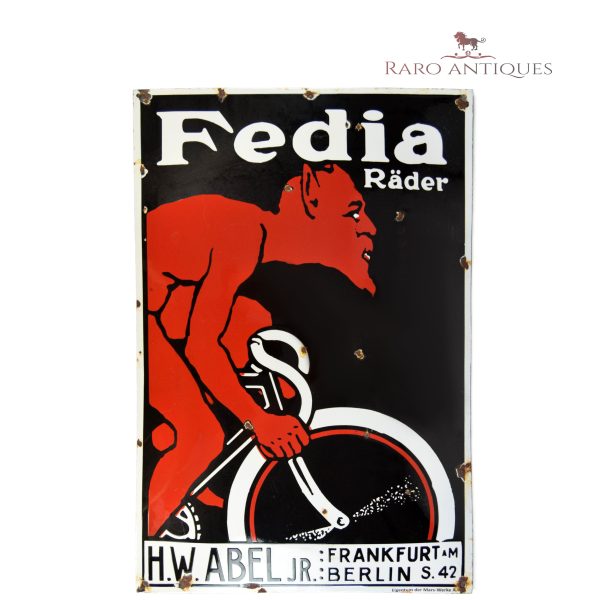
ART DECO ENAMEL ADVERTISING SIGN
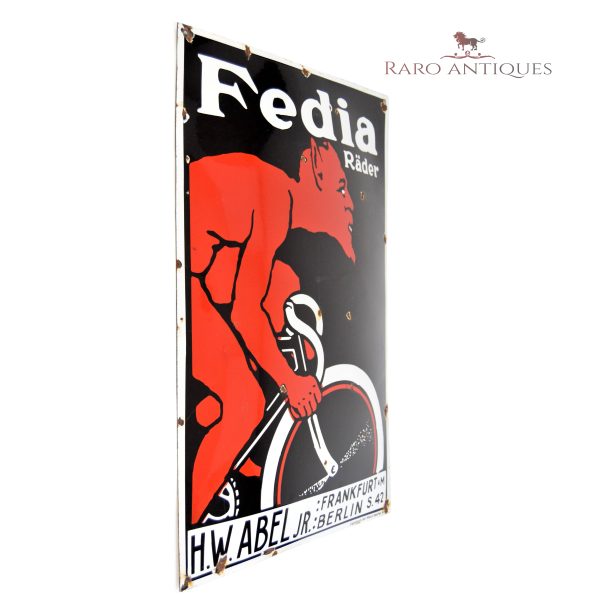
Advertising sign for Fedia Räder, made circa 1935.
An exceptional enamel sign in a characteristic Art Deco design, featuring the image of a red devil on a racing bicycle—symbolizing the Fedia Räder company since the 1930s. The red devil was an apt choice as a symbol, representing determination, perseverance and risk-taking, perfectly capturing the spirit of this German company renowned at its peak for producing high-quality bicycles. This sign, created for promotional purposes, was crafted in the 1930s from thick metal, with a raised design to emphasize its striking imagery. Such enamel signs are rare and highly sought after by collectors of vintage signs and cycling enthusiasts. Whether displayed in a garage by cycling aficionados or as a vibrant piece of art in your home, its symbolism, vibrant colors, and Art Deco aesthetics are guaranteed to enliven and enrich any space. Dimensions: 60 x 40 x 3 cm Weight: 3 kg The advertising sign is in good condition.
ANTIQUE CANDLESTICK
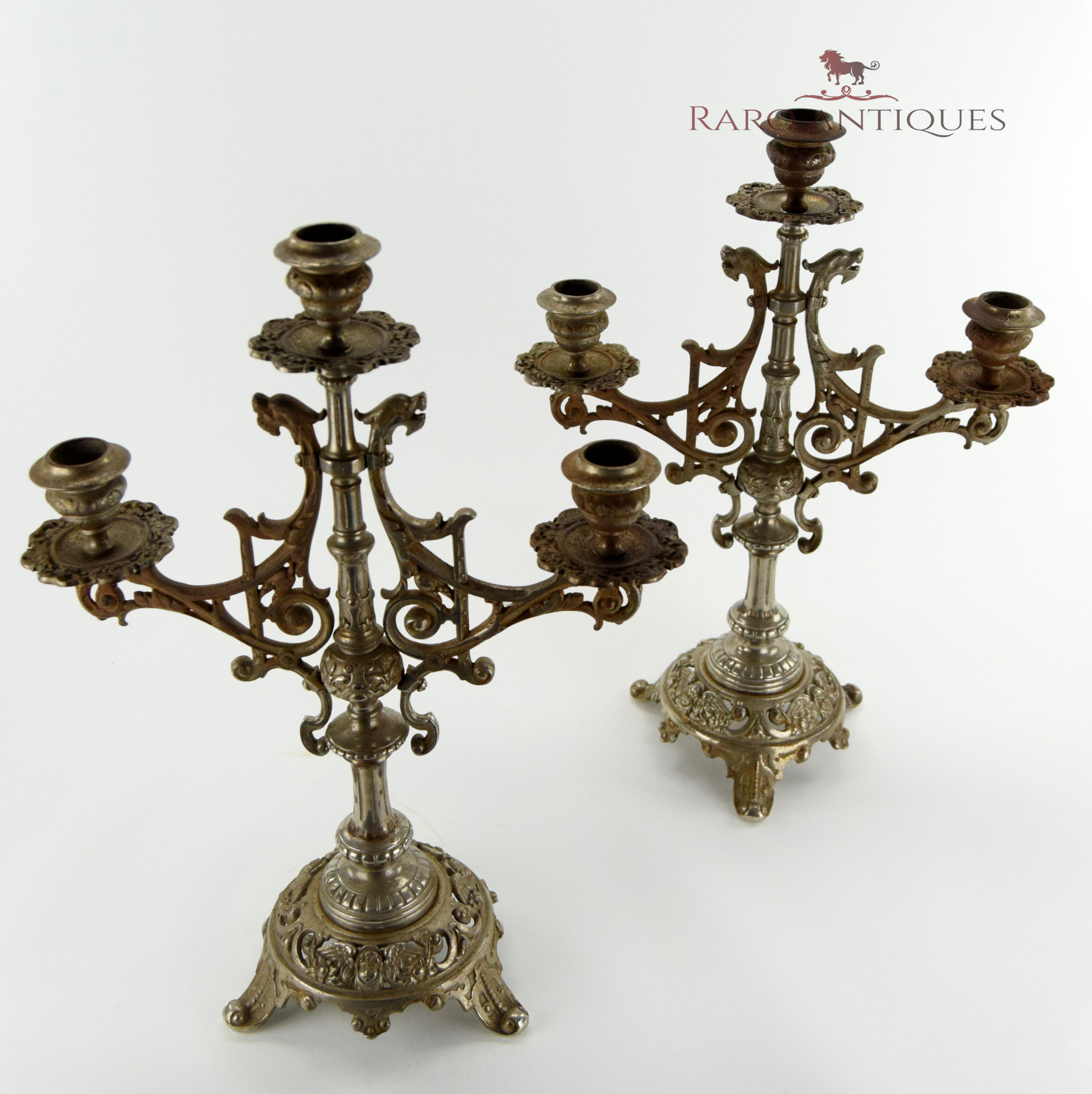
Antique candlestick, from the late 19th century.
A pair of candlesticks, remarkable for their size and richness of symbolism and decorations, including angels and gargoyles. A wonderful addition to any collection and a perfect piece for home decoration. Candlesticks are a welcome ornament in any home. They can illuminate a festive dinner in the dining room or create a romantic atmosphere in the bedroom. Whichever way they are used, candlesticks are undoubtedly one of those items that come in handy on every occasion. Dimensions: 41 x 30 x 15.5 cm Weight: 1 kg The candlesticks are well preserved. Price is for one.

ANTIQUE INKWELL
Antique inkwell, from the early 20th century, made in France.
A luxurious inkwell from the Art Nouveau period, adorned with exceptional leaf and floral patterns. The inkwell still retains its original undamaged glass containers. Ah, the days when everything was written with a quill, and desks were stained with ink. Now you can embellish your own desk with this beautiful inkwell. Even if you might not use it, it will surely stimulate your imagination and transport you to another era. Perhaps you practice calligraphy or simply adore the old-fashioned way of writing, in which case, this inkwell will undoubtedly come in handy. Besides being a delightful decoration for your desk, it also serves as an excellent tool for writing. Dimensions: 31.5 x 19 x 9 cm Weight: 1300 g The inkwell is in excellent condition.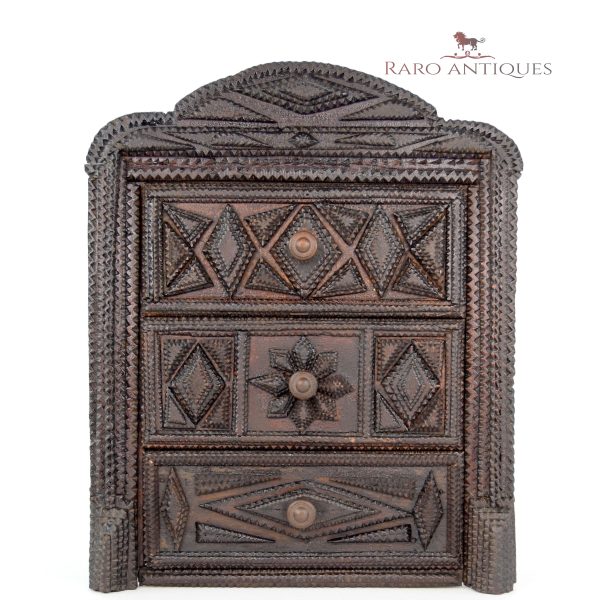
MINIATURE TRAMP ART CHEST OF DRAWERS
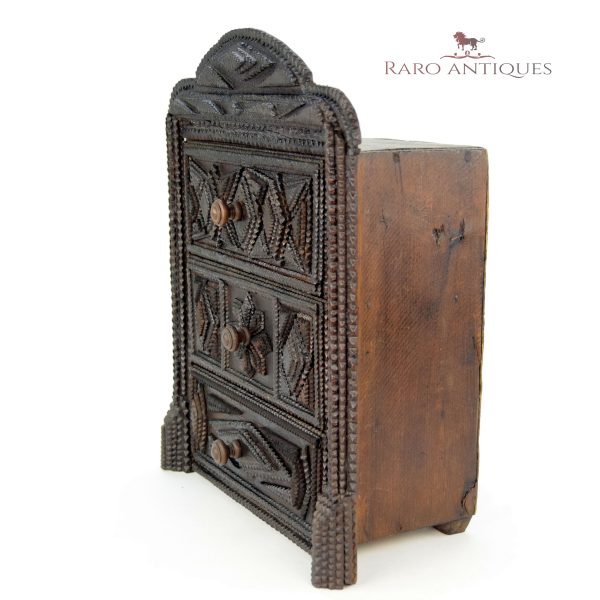
Miniature tramp art chest of drawers, circa 1880.
An exceptional miniature tramp art chest of drawers, crafted from cigar boxes, as evidenced by its interior.The chest enchants with its rich, geometric decoration, characteristic of the tramp art technique, where individual pieces of wood are meticulously cut, shaped, and layered.Countless hours of handwork have been invested into this piece, making it truly unique and one of a kind.This miniature chest, with its three drawers, is a beautiful example of masterful craftsmanship, combining remarkable precision and patience.A perfect addition for collectors of folk art, lovers of unique interiors, or as a special decorative accent.
You can learn more about tramp art in our blog post.
Dimensions: 38 x 31 x 16 cm
Weight: 1,9 kg
The miniature chest is in excellent condition.


CHANDELIER J. T. KALMAR “SONNE”
Chandelier flush mount, designed by the Austrian designer J.T. Kalmar.
The "Sonne" chandelier, meaning "sun" in German, is an interesting modernist fixture whose design seamlessly integrates into any contemporary space. With its simple yet sophisticated lines, this light fixture is not just for illumination; it adds a touch of style to your space. The small glass flowers at the tips further emphasize the opulence of this chandelier, which can also be used as a wall light. Austrian designer and entrepreneur Julius Theodor Kalmar was born in 1884 in Vienna to Julius August Kalmar, the founder of the eponymous company specializing in chandeliers and other objects made of cast bronze. Growing up surrounded by design due to his father and their company, Julius Theodor gained rich design knowledge from an early age. His educational journey led him to the Birmingham School of Art and the University of Applied Arts in Vienna, where he studied under the mentorship of the Secessionist architect Josef Hoffmann. After completing his studies, Julius Theodor joined his father's company in 1906 and took it over in 1913. Under his leadership, the company shifted away from the classical design of the time. Kalmar developed his distinctive design aesthetic, emphasizing the integration of form and function and combining classical traditions with innovative ideas. By the mid-1920s, his products were among the most sought after. In the 1930s, Kalmar began collaborating with the Austrian Werkbund, creating a series of glass lights with a purist aesthetic. Throughout his career, he collaborated with renowned architects such as Oskar Strnad, Josef Frank, and Oskar Wlach. In the last decade of his life, he designed numerous light collections, including the popular Atomic collection. Kalmar passed away in 1968, but the Kalmar company continues to create luxury lighting to this day. Kalmar lights can be found in prestigious locations like the Kremlin Presidential Palace and the Burj Tower in Dubai. Dimensions: 49 x 14 cm Weight: 1 kg The light fixture is in good condition, showing patina on the brass. Compatible with E14 bulbs.
VASE PIERO FORNASETTI
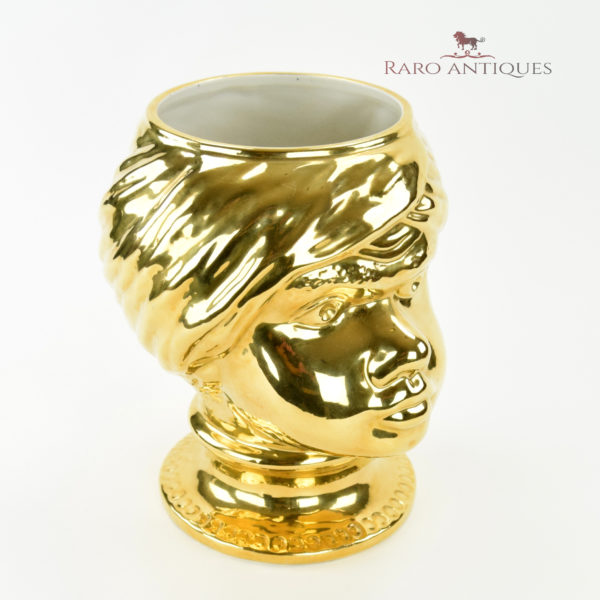
Vase, by Piero Fornasetti, from the 1960s.
A gilded porcelain vase depicting the head of a Moor, by the renowned Italian artist Piero Fornasetti. This beautifully elegant and highly decorative piece will proudly draw attention in your home, adding a touch of sophistication to any space. Truly exceptional, it will serve as the perfect finishing touch to any room. At the base, you'll find the inscription "Galerie Schöninger München," indicating that it was once in their possession. Piero Fornasetti (1913-1988) was a versatile Italian artist whose work transcends categorization within any specific period. He operated according to his own principles, disregarding the norms and designs of his time. Engaging in various aesthetic disciplines including painting, drawing, graphic design, and product design, his creativity peaked in the 1950s. At the behest of Gio Ponti, he opened his studio in Milan, where he designed and created everyday objects enriched with decoration that brought art into the homes of ordinary people. As an artist ahead of his time, Fornasetti's work significantly influenced contemporary culture, reshaping taste and creating a unique and instantly recognizable style. Dimensions: 26 x 25 x 24 cm Weight: 1800 g The vase is in excellent condition.
ART NOUVEAU CANDLESTICK
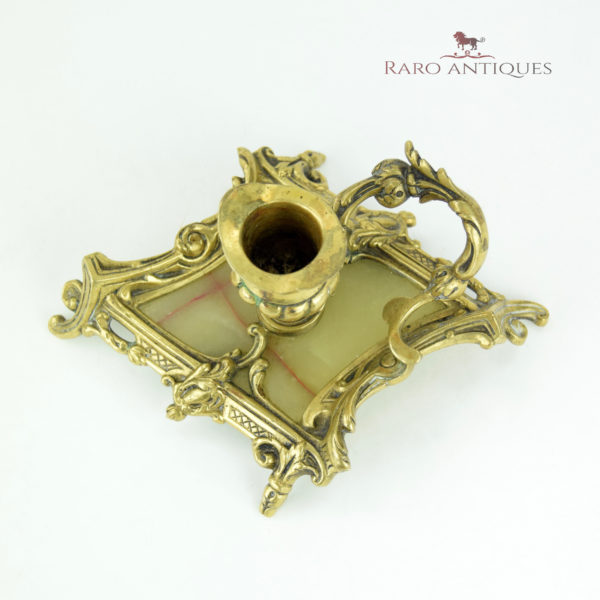
Art Nouveau candlestick, late 19th century.
An exceptional candlestick made of brass and onyx. The impressive craftsmanship of the brass highlights the superior quality of this piece, making it a remarkable addition to any table or shelf. Candlesticks are a welcome decoration in any home. They can be placed in the dining room to illuminate a festive dinner or in the bedroom to create a romantic atmosphere. No matter how you use it, a candlestick is undoubtedly one of those items that proves useful for any occasion. Dimensions: 16 x 8 cm Weight: 450 g The candlestick is in excellent condition.

ANTIQUE COFFEE TABLE
Coffee table from the first half of the 20th century, made in Italy.
An exceptional coffee table featuring a carved and gilded wooden base, crowned with a stunning marble top with elegantly curved edges. Masterfully crafted, this coffee table exudes extraordinary quality and can now become a part of your living space—whether in the living room or a social lounge. It will undoubtedly transform the room, adding a luxurious touch and a vintage charm. Its timeless design ensures that it stands out in a modern minimalist setting, while it can also seamlessly complement already stylized interiors. A coffee table that will captivate anyone who lays eyes on it. Dimensions: 130 x 55 x 48 cm Weight: 35 kg The coffee table is in excellent condition.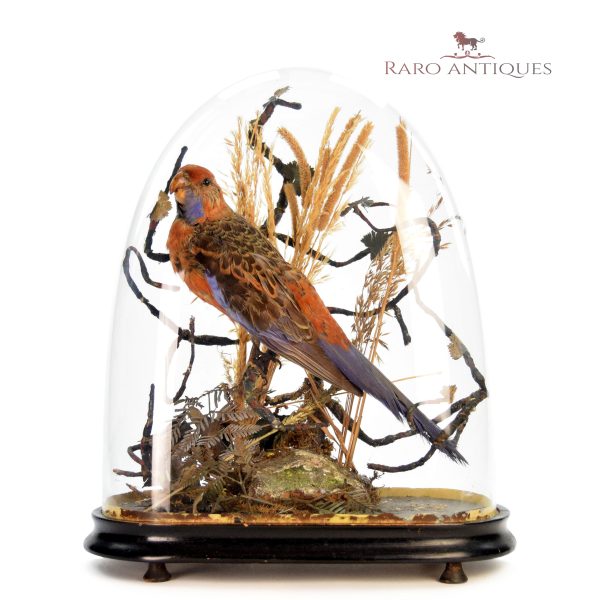

VICTORIAN TAXIDERMY ROSELLA PARROT
Rosella parrot under a glass dome, circa 1880.
The presented rosella parrot comes from the 19th century, a time when placing taxidermied animals under glass domes was a popular practice, particularly during the Victorian era. This tradition stemmed from a passion for natural history collections known as "cabinets of curiosities," where people would gather and display natural wonders such as minerals, exotic plants, and animals. Glass domes were often used to protect and showcase these collectible items, especially taxidermied animals. The popularity of this practice grew alongside a rising interest in natural sciences, fueled by major scientific discoveries and expeditions to exotic lands, which introduced new animal species. These collections reflected a sense of awe and fascination with nature, and they were part of the Victorian obsession with documenting and classifying the world. Taxidermy during this period was not only a scientific practice but also became a form of home decoration. Taxidermied animals under glass domes were displayed in homes as symbols of refined taste and education. The domes were designed to protect the specimens from dust and damage, allowing for long-term preservation. Within these glass enclosures, taxidermied animals were often arranged in elaborate scenes that could depict them in their natural habitats – as with the presented rosella parrot – or sometimes in purely artistic or imaginative settings. These exhibits were intricately crafted and carefully arranged to create the illusion of realism. However, by the end of the 19th century, this trend gradually faded as aesthetic tastes changed, as did the relationship with nature and animals. Dimensions: 40 x 34 x 16 cm Weight: 1.5 kg The rosella parrot exhibit under the glass dome is in excellent condition.

BIEDERMEIER CHANDELIER
Biedermeier chandelier from the early 19th century.
An exceptional wooden chandelier, originally designed for candles, has been electrified to illuminate your home or business space. This chandelier is a true representation of the luxury of bygone times. With wooden details on both the chain and the frame, it is a timeless piece that complements almost any style. Dimensions: 95 x 85 cm Weight: 3.2 kg The chandelier is in excellent condition. Suitable for six E14 light bulbs.

ANTIQUE CHANDELIER
Antique chandelier from the Art Nouveau period, crafted between 1900-1910.
An exceptional chandelier made of chased brass and adorned with beautiful glass pendants. It features depictions of dragonflies and flowers, making it even more unique. This chandelier is extremely decorative and elegant, transcending its function as a mere light fixture to become a work of art that will be admired by all. Dimensions: 98 x 62 cm Weight: 6.5 kg The chandelier is excellently preserved and rewired. Suitable for four E27 bulbs.

WALL LIGHT BAROVIER & TOSO
Wall light made of Murano glass from the famous Italian company Barovier & Toso, dating back to the 1950s, 20th century.
An intriguing wall light crafted from handmade Murano glass flowers. Perfect for enriching and enlivening any wall. Thanks to its colorful glass, it emits a beautiful light. Barovier & Toso is one of the oldest family-run companies still in operation today. Its roots trace back to the year 1295 on the island of Murano, where Jacobello, an ancestor of the Barovier family, officially began leading the family's glassmaking craft. They introduced several innovations to the world of glassmaking, with one of the most significant being the chemical discovery by Angelo Barovier in 1450, who found how to produce the first completely transparent glass. The company is still highly acclaimed today, and their glass artworks, such as lights, can be found in the most prestigious establishments like Cartier, Dior, and Dolce & Gabbana. Dimensions: 23 x 19 x 10 cm Weight: 980 g The light is in excellent condition. For an E14 bulb.

VINTAGE NEON SIGN
Vintage neon sign "Apollo11", from the early 1970s.
A rare neon sign with original working neon tubes. Want something extraordinary in your home? Something out of this world? Then this is the perfect decorative piece for you. It will stand out in any home or establishment, captivating everyone with its size and neon lights in three colors. Due to its association with the first manned Moon landing, it's not just a collector's item but also a reminder of a historic event that will remain in the collective memory of humanity and an unforgettable moment in global culture. Apollo 11 was the first manned space mission to land on the Moon. In 1969, when the landing occurred, millions of people were glued to their television screens, as the Moon landing had been a subject of fascination for years. People were anxious, not knowing what might befall the first astronauts. Would they encounter extraterrestrials? Would harmful radioactive rays kill them? There were more questions than answers, but people were still more curious and excited than frightened, thrilled that humanity could land on the moon and even travel through space. The successful landing and subsequent return to Earth thrilled humanity and inspired the imagination for years to come. It was and will forever be a story of what is possible with science, technology, and the will to achieve the impossible. Therefore, it's not surprising that during that time, people almost worshipped the Apollo 11 mission and produced items with a space theme. The first neon lights appeared as early as 1890, but they were used exclusively for industrial purposes, such as by miners in France who had neon lamps. Neon lights as we know them today appeared around 1910 when they were invented by French innovator Georges Claude. The first neon sign was created in 1915 for a Parisian hair salon. In 1923, the motor company Packard Motors purchased two neon signs for advertising in Los Angeles, bringing neon signs to America for the first time, where their popularity soared. Claude held a patent on neon lights, giving him a monopoly on them in the 1920s. Only after the patent expired and the secret of making these bright lights was revealed did others have the opportunity to start manufacturing them. That's when their popularity skyrocketed. In the 1930s, neon lights could be found in the Moulin Rouge in Paris, on the Las Vegas Strip, and in New York's Times Square. Over the next few decades, neon provided vibrant light, transforming ordinary buildings into continuous advertising displays for all types of businesses. Neon lights were even used for political purposes. In communist countries, buildings were decorated with them to give city residents the glamorous feel of Western metropolises. However, making neon lights was quite time-consuming and complex, as they had to be hand-blown and shaped, and then filled with gas. They also began to lose their futuristic charm in the 1960s, leading to a decline in their popularity, as they were replaced by more modern and cheaper lighting products. Today, they are a popular home decoration, rarely used for advertising purposes like in their early days. Dimensions: 156 x 34.5 x 9 cm Weight: 16 kg The neon sign is in excellent condition. The neon tubes are original and working.

ANTIQUE ELEPHANT SCULPTURE
Antique elephant, a large wooden sculpture from the first half of the 20th century.
This elephant sculpture will be an exceptional addition to any home due to its size and beautiful details. Also, because of the symbolism associated with elephants, there should be at least one representation of an elephant in every home. Elephants have always been regarded as bearers of wisdom, happiness, and positive energy. In Hinduism, elephants symbolize integrity and strength. According to Vastu Shastra (traditional Indian architectural system), placing an elephant sculpture near the entrance door can help protect your home from negative energies and invite luck inside. You can place it in the marital bedroom, as the elephant symbol is believed to strengthen relationships, enhance fertility, and prevent infidelity. To aid a child in their studies, place the elephant sculpture on their study desk, as it is said to enhance knowledge and improve concentration. For business success, position the elephant sculpture near the main entrance, as its presence will energize your business. Although elephants with raised trunks are believed to bring luck, the symbolism of an elephant with a lowered trunk is also considered auspicious. A lowered trunk is said to represent longevity and the ability to overcome challenges. The black color of the elephant represents prosperity and success. Therefore, this beautiful elephant sculpture, handcrafted from exotic hardwood, can be the perfect gift for yourself and your home. Dimensions: 47 x 35.5 x 22 cm Weight: 11 kg The elephant is excellently preserved.

ANTIQUE BUST SCULPTURE
Antique bust sculpture, created in 1906, by Italian sculptor Emilio Marsili.
The bust sculpture of an elderly man will be an intriguing addition to your home or institution. You can hang it on the wall or place it on a shelf/table. The sculpture has been evaluated by the museum in Rome, ensuring that you'll be bringing top-notch art from the previous century into your spaces. This offers you an excellent opportunity to own a piece by the esteemed sculptor, whose works are otherwise displayed in museums. Emilio Marsili was born in Venice in 1841. He trained as a sculptor at the Venetian Academy under L. Ferrari, then moved to Paris, where his Venetian education flourished, making him extremely popular. After Paris, he moved to Belgium, inspired by the sculptors there. However, homesickness drew him back to Venice, where he continued to dedicate himself to his craft. During that time, he contributed to the remodeling of Palazze Cavalli Franchetti, created a bust sculpture of Vittorio Emanuele II for the town hall in Pordenone, and crafted a relief for the facade of the Pietà church in Venice, which can still be found there today. In those years, he also received his first recognitions for his work, not only in his native Italy but also receiving awards in Vienna and Paris, with museums beginning to acquire his works. He was described as an "aristocratic artist" endowed with "an instinctive sense of measure, allowing him to be lively without being vulgar and strict without being harsh." In later years, he became known primarily for crafting prestigious tombstones, including one for Queen Margherita of Savoy. He passed away in 1926 in Venice, and his works remain part of museums today, highlighting his enduring creative energy, which is still appreciated to this day. Dimensions: 68 x 65 x 40 cm Weight: 12 kg The bust sculpture is well-preserved and signed.

VINTAGE FREESTANDING MIRROR
Vintage freestanding mirror from the second half of the 20th century.
A freestanding mirror, on a sturdy brass stand, with the back dressed in beautiful fabric, will be an exceptional addition to the hallway, bathroom, or bedroom, allowing you to always check yourself from head to toe. It would also fit remarkably well in a clothing boutique or fashion studio. Due to its adjustable tilt, it is extremely versatile, and because of its exceptional details, it is also an excellent decorative piece. The mirror is not just a beautiful ornament for the wall but is one of the key elements in a home. Think about it; we have them in hallways, at entryways, in bedrooms, and last but not least, in bathrooms, serving as a tool for personal grooming. Mirrors can also be a wonderful source of light, so we can hang them in rooms where they are not typically needed, visually enhancing the space and adding some brightness. With old mirrors, which also exhibit a beautiful patina, we bring uniqueness into our homes, inspiring us for years to come. Dimensions: 166 x 56 x 48 cm Weight: 18 kg The mirror is in excellent condition.
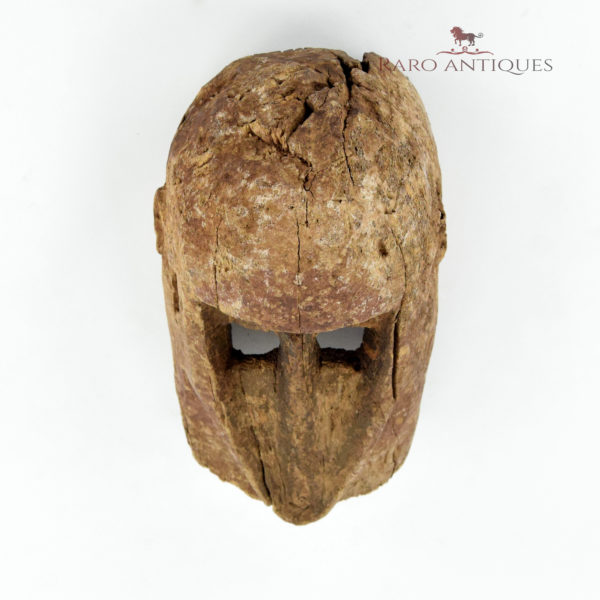
DEGE MASK
Dege Mask.
An African mask depicting the black monkey "Dege," from the Dogon people. The Dogon are an ethnic group in Mali. Masks crafted by this African tribe come in various styles, employing different geometric shapes in their designs, depending on the animal the mask is meant to represent. Most masks feature large eyes and stylized features, often painted or colored with various substances. The Dogon have been using masks since ancient times, particularly during the Dama ceremony, a memorial ritual for the deceased, believed to guide them to the realm of ancestors and restore order in the universe. These ceremonies often require a large attendance, with several hundred accompanying the deceased. Masks also appear in "baga-bundo" rites, performed before the burial of a Dogon male, which typically involve fewer participants. Inspiration for the masks comes from the animals found in their region, with common depictions including antelopes, rabbits, lions, hyenas, cows, birds, and monkeys. The specific mask represents the black monkey Dege. The Dogon typically use three types of monkey masks, distinguished only by color rather than shape. The black monkey is known as Dege, the white monkey as Omono, and the red monkey as Ko. Dimensions: 33.5 x 18.5 x 16 cm Weight: 1 kg The mask is in excellent condition.

ANTIQUE ONYX PEDESTAL
Onyx pedestal, made in the 19th century.
An elegant pedestal carved from green onyx, featuring a stepped octagonal base, a finely carved, fluted and spirally twisted shaft, and a richly ornamented capital with classical detailing — clear evidence that this piece was crafted by the hands of a master stone carver. This outstanding decorative object brings architectural structure to any interior, while the polished green onyx, with its beautiful natural veining in warm, translucent tones, offers an attractive support for a sculpture, bust, vase, or other decorative object. Whatever you choose to display on this exclusive piedestal, it will undoubtedly create a striking focal point in the room.
Dimensions: 118,5 × 34 × 34 cm
Weight: 46,2 kg
The onyx pedestal is in very good condition.