
Items that, due to their unique and specific characteristics, do not belong to a specifically defined category. Therefore, this category is where you will find interesting and unusual objects.
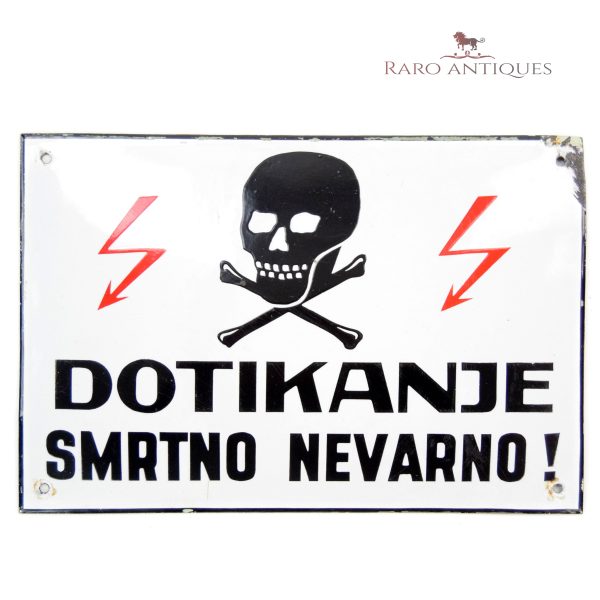
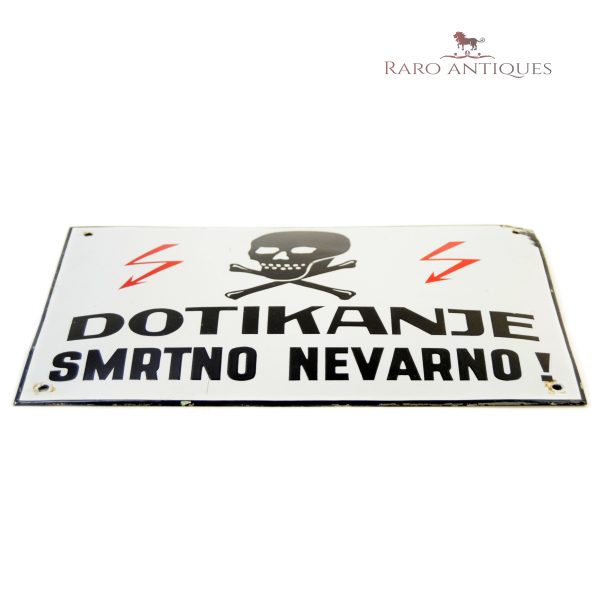
ENAMEL WARNING SIGN
Enamel warning sign made in the mid-20th century.
An original industrial warning sign featuring raised lettering and a skull motif.
Dimensions: 30 × 20 × 2 cm
Weight: 0,5 kg
The warning sign is in excellent condition.
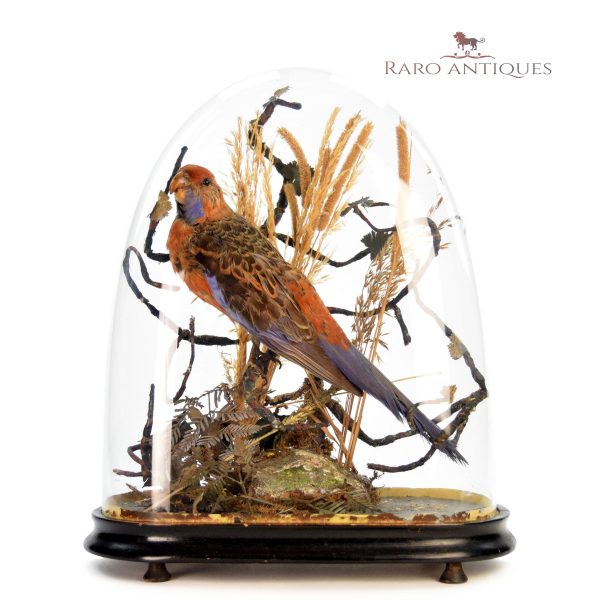

VICTORIAN TAXIDERMY ROSELLA PARROT
Rosella parrot under a glass dome, circa 1880.
The presented rosella parrot comes from the 19th century, a time when placing taxidermied animals under glass domes was a popular practice, particularly during the Victorian era. This tradition stemmed from a passion for natural history collections known as "cabinets of curiosities," where people would gather and display natural wonders such as minerals, exotic plants, and animals. Glass domes were often used to protect and showcase these collectible items, especially taxidermied animals. The popularity of this practice grew alongside a rising interest in natural sciences, fueled by major scientific discoveries and expeditions to exotic lands, which introduced new animal species. These collections reflected a sense of awe and fascination with nature, and they were part of the Victorian obsession with documenting and classifying the world. Taxidermy during this period was not only a scientific practice but also became a form of home decoration. Taxidermied animals under glass domes were displayed in homes as symbols of refined taste and education. The domes were designed to protect the specimens from dust and damage, allowing for long-term preservation. Within these glass enclosures, taxidermied animals were often arranged in elaborate scenes that could depict them in their natural habitats – as with the presented rosella parrot – or sometimes in purely artistic or imaginative settings. These exhibits were intricately crafted and carefully arranged to create the illusion of realism. However, by the end of the 19th century, this trend gradually faded as aesthetic tastes changed, as did the relationship with nature and animals. Dimensions: 40 x 34 x 16 cm Weight: 1.5 kg The rosella parrot exhibit under the glass dome is in excellent condition.

ANTIQUE ONYX PEDESTAL
Onyx pedestal, made in the 19th century.
An elegant pedestal carved from green onyx, featuring a stepped octagonal base, a finely carved, fluted and spirally twisted shaft, and a richly ornamented capital with classical detailing — clear evidence that this piece was crafted by the hands of a master stone carver. This outstanding decorative object brings architectural structure to any interior, while the polished green onyx, with its beautiful natural veining in warm, translucent tones, offers an attractive support for a sculpture, bust, vase, or other decorative object. Whatever you choose to display on this exclusive piedestal, it will undoubtedly create a striking focal point in the room.
Dimensions: 118,5 × 34 × 34 cm
Weight: 46,2 kg
The onyx pedestal is in very good condition.

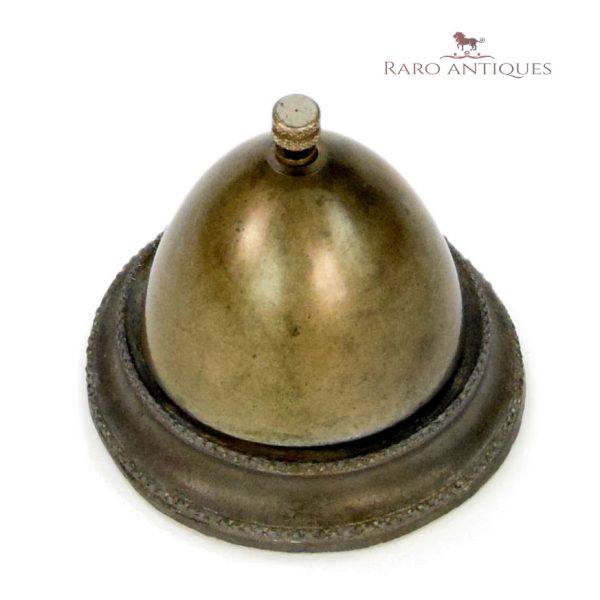
DESK BELL
Desk bell, late 19th century.
A metal desk bell that rings when the button on top is pressed. It was most likely used in establishments such as hotels, shops, or reception desks, where customers could use it to attract attention.
Throughout history, desk bells were primarily used in aristocratic households. During long dinners, they were used to summon a maid to serve another course or refresh drinks. This practice was especially common in America, whereas in Europe it was more customary for servants to remain near the dining table and attend to guests' needs directly. Desk bells became widely used across Europe during the 19th century, when hotels, restaurants, shops, and other public establishments created a growing demand for them.
Today, this bell can once again become a practical and decorative piece for your home, shop, or business.
Dimensions: 8 x 9 x 9 cm
Weight: 0,3 kg
The bell is in excellent condition and remains fully functional.


ANTIQUE HAT STAND
Antique hat stand from the mid-19th century.
Turned wooden hat stand will be an excellent addition to any wardrobe, as you can keep your favorite headwear on it. Since it was originally made as a display item in millinery, it can find its place there again. Dimensions: 39 x 14 cm Weight: 320 g The hat stand is in good condition.

TORTURE COLLAR
Torture collar from the second half of the 18th century.
An interesting object from bygone times that reminds us of the dark past of humanity. Torture devices like this one were popular since the Middle Ages and were used to humiliate, torture, and control convicts and slaves. The collar was placed around a person's neck, preventing normal movement, lying down, and overall comfort. Similar collars were also used on dogs, but without a lock, only with a buckle. In this case, the collar served to protect a dog guarding livestock from potential wolf attacks. Dimensions: 30 x 8 cm Weight: 1.1 kg Considering its age, the collar is excellently preserved, with patina that speaks to its history. It includes a lock, but without a key.

ANTIQUE BABY CARRIAGE
Vintage baby carriage from 1910, made in Germany by Brennabor.
A nostalgic piece of the past, this vintage baby carriage can now serve as an interesting decoration in your home or office space. Suitable for planting flowers in it, it is already highly decorative and will be a nostalgic addition that brings history into your living space. Dimensions: 110 x 96 x 54 cm Weight: 15 kg The baby carriage is well-preserved.

ANTIQUE FIREPROOF SAFE
Fireproof safe made by R. Tánczos, Vienna, circa 1885.
An exceptionally well-preserved small-format fireproof safe from the renowned Viennese factory R. Tánczos, established in 1869. This was the first manufacturer of fireproof safes in the Austro-Hungarian Empire, combining impregnated wood with an iron casing — an innovation of its time. Additionally, it was protected with fire-resistant materials, ensuring a high level of safety for its contents even in the event of a fire.
The safe retains its original interior label, richly decorated with gilded and ornamental printing, also stating the successful fire resistance tests held before the authorities of Vienna on July 6th and December 1st, 1885. On the lid, a heavy brass badge is stamped with the inscription “FEUERFEST PATENT TÁNCZOS WIEN”, further confirming the authenticity and high quality of its craftsmanship. Two original keys are included, which is a true rarity for such items.
Today, this safe is an excellent collector’s item as well as a functional decorative piece.
Dimensions: 43 x 29,5 x 19 cm
Weight: 21,3 kg
The safe is well preserved and in working condition.


ANTIQUE ICE BUCKET
Ice bucket, from the 1913.
An exceptional ice bucket, commemorating the 30th anniversary of the Milanese gymnastics club Pro Patria, as engraved on the bucket itself. The ice bucket displays all the marks of top-tier craftsmanship. Its most beautiful details are undoubtedly the intricately crafted elephants, along with the festive garland encircling the bucket, further emphasizing its luxurious design. This exquisite piece serves both as a decorative and functional item, ideal for chilling champagne during special occasions. Its beauty ensures it will also find a prominent place on your shelf, where you can admire it daily. Dimensions: 46 x 38 x 22 cm Weight: 2.8 kg The ice bucket is in good condition.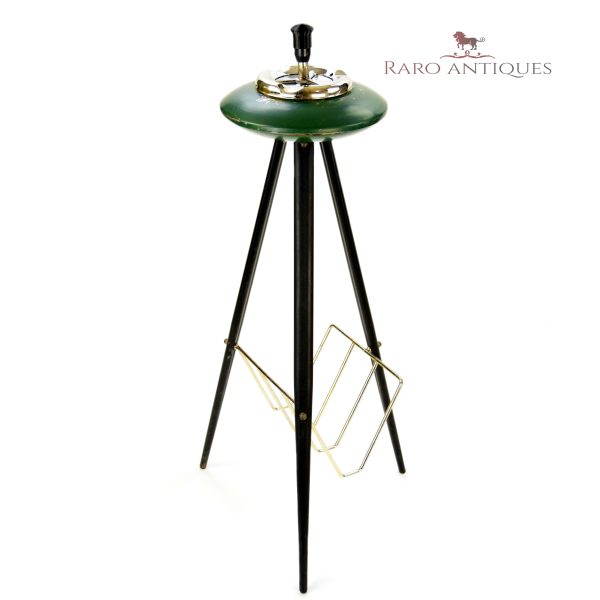
VINTAGE FREESTANDING ASHTRAY
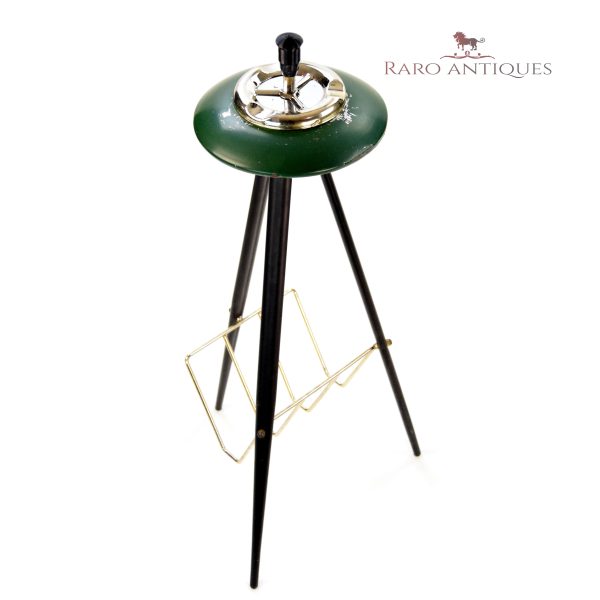
Freestanding ashtray, made in the mid-20th century.
This freestanding ashtray features a push-button mechanism that closes the ash inside the container, helping to reduce the spread of odors. It also includes a convenient holder for magazines and newspapers. Suitable for indoor use or on a terrace, and with its modernist design it also works as a striking decorative piece.
Dimensions: 65 × 30 × 27 cm
Weight: 1,5 kg
The freestanding ashtray is in good condition.


ANTIQUE MEDICAL CHEST
19th-century medical chest, made in France.
This rare wooden medical chest is a relic from the era when home remedies were essential, especially for families living far from cities and medical care. Such chests were used to store a variety of medicinal preparations to provide aid for all family members. This particular chest contains 19 glass bottles, some still holding remnants of their original contents, a wooden case for a thermometer, antique gauze, and a small box with a glass syringe accompanied by various ampoules, also retaining their original contents. Due to its remarkable preservation, this piece is a true museum artifact, ideal for collectors, medical history enthusiasts, and lovers of historical treasures. Exploring its contents is an educational journey, while the chest itself serves as an unusual and fascinating decorative item. Dimensions: 44 x 29 x 19 cm Weight: 7.7 kg The medical chest is in excellent condition.

ANTIQUE KNIFE
Antique knife with a brass handle.
Dimensions: 36 cm Weight: 530 g The knife is well-preserved.

VINTAGE ICE BUCKET
Ice bucket made in Switzerland in the mid-20th century.
An elegant ice bucket featuring lion head handles. Perfect for serving chilled drinks in style, and thanks to its classic design, it also makes an excellent decorative piece for your cocktail corner or home bar.
Dimensions: 24 × 20 × 16 cm
Weight: 1,5 kg
The ice bucket is well preserved.


ANTIQUE SHEET MUSIC STAND
Antique sheet music stand from the 19th century.
A fully hand-forged sheet music stand. An excellent tool for any instrumentalist, as well as an exceptional decorative addition to the room where it will be used. The stand is adjustable in height, making it particularly convenient. It could also be used in a pub or restaurant to present a menu. Dimensions: 105-133 x 50 x 30 cm Weight: 12.5 kg The sheet music stand is in excellent condition.

ANTIQUE TOILET PAPER HOLDER
Toilet paper holder, made in the early 20th century.
Decorative wall-mounted piece made of wood and metal. In addition to holding a toilet paper roll, it features a small shell-shaped tray at the top for placing small items.
A beautiful and practical piece to enhance your bathroom.
Dimensions: 30 × 19 × 5 cm
Weight: 0,6 kg
The toilet paper holder is well preserved.


WROUGHT IRON BOX, 1946
Wrought iron box, made in 1946, Germany.
A fully hand-forged iron box made by the craftsman FR. Sauer in Essen-Steele, Germany. A solid and heavy piece with beautiful decorative wrought iron details and an original working lock with key. In addition to its exceptional craftsmanship, what makes this piece especially remarkable is the year of its production. The year 1946, immediately after World War II, was a time of extreme material shortage in Germany. Objects like this were often made from recycled iron and produced in small artisan workshops, as industrial production had not yet fully recovered. This is also confirmed by the stamp on the bottom of the box.
This iron box therefore represents a high-quality example of post-war craftsmanship and a small but authentic piece of history.
Dimensions: 32 × 19,5 × 13,5 cm
Weight: 4,1 kg
In excellent condition.


SCOLD’S BRIDLE
The scold's bridle.
The scold's bridle or brank, originating from Scotland in the 16th century, was a horrific device designed to cause shame, discomfort, and pain to its wearer. Its usage spread from Scotland to England, Germany, and other European countries. Its purpose was to shame, silence, and physically discomfort individuals who were deemed unruly or outspoken, particularly women who challenged authority or societal norms. Often, these bridles were crafted to resemble masks with distorted facial features, such as large ears, noses, or horns. Some even had bells attached to them, further humiliating the wearer and drawing attention to their presence. The bridle, worn for a minimum of several hours, prevented its wearer from eating, drinking, and most importantly, speaking. It consisted of a metal part inserted into the mouth, similar to a bit in a horse's harness, which held the tongue in place. In more severe cases, these metal mouthpieces had spikes, causing additional pain. The bridle was predominantly used as a punishment for women who were considered too vocal or contentious in public, especially widows or older women who were not under male control. It was also known as a "witch's bridle," indicating its use during witch trials to prevent accused witches from casting spells on their captors or communities. Additionally, disobedient wives could be subjected to this punishment at their husbands' request. While men could also face this punishment if perceived as a threat to the common good, it was primarily reserved for women deemed gossips, adulterers, prostitutes, or witches, as well as those who defied societal norms. The bridle served as a stark reminder of the oppression women faced and the consequences of expressing dissent in conservative societies. Remarkably, this punishment was not abolished in England until 1967, reflecting the enduring legacy of patriarchal control and the gradual progress towards women's rights. The scold's bridle serves as a poignant relic of the past, prompting reflection on the darker aspects of human history. Dimensions: 26 x 25.5 x 21 cm Weight: 3.2 kg The scold's bridle is in excellent condition, complete with a lock and accompanying key.

ANTIQUE CRUCIFIX
Antique crucifix from the 19th century.
A crucifix with a few missing pieces, which makes it uniquely special. An exceptional piece that reflects the passage of decades. Dimensions: 46 x 21 x 8.5 cm Weight: 0.5 kg The crucifix is well-preserved.

ANTIQUE COSTREL
Costrel, made in the 19th century.
A costrel, or hand barrel, was used for storing liquids, primarily wine. It is made of treated oak planks, bound together with hand-forged iron hoops. The costrel is in its original condition and has a beautiful patina that reflects its age. This is, in fact, a piece of cultural history, a reminder of the traditions and ways of life of past centuries. An exceptional item for collectors and history enthusiasts. Dimensions: 27 x 20 x 15 cm Weight: 1 kg The costrel is in good condition.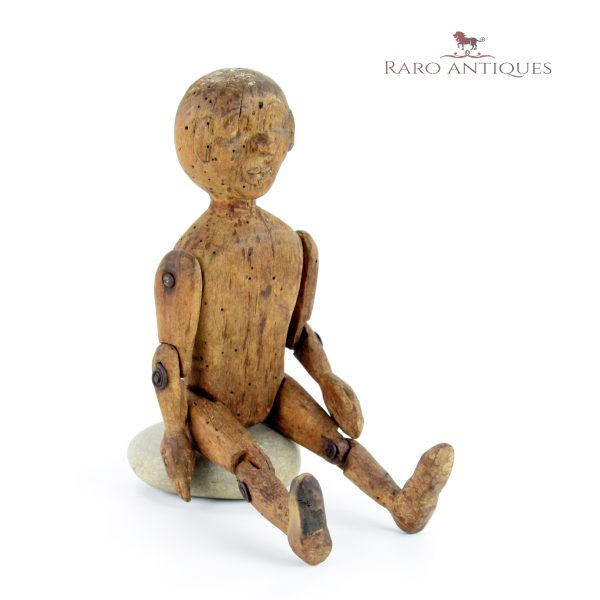
WOODEN TOY FROM 19TH CENTURY
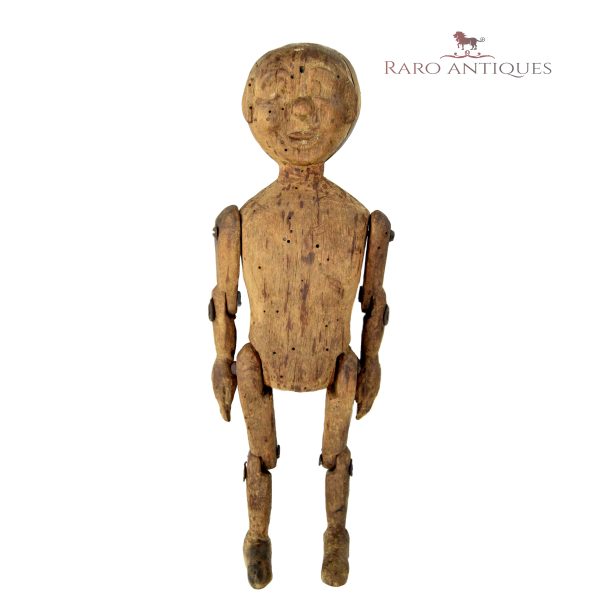
Charming wooden toy from the mid-19th century.
This delightful wooden toy with joints on its legs and arms undoubtedly once entertained many children's hearts. The toy is crafted in a naive style, adding to its charm and placing it within the realm of folk art. One can imagine a father crafting this exceptional toy for his child sometime in the mid-19th century. The child or perhaps multiple children must have cherished it dearly, as there are traces of past repairs, indicating efforts to keep the toy joyfully functional. Now, it stands as a wonderful example of naive and folk art, serving as both decoration and a reminder of a bygone era when toys were not so plentiful. Dimensions: 29 x 10 x 6 cm Weight: 200 g The toy is well-preserved.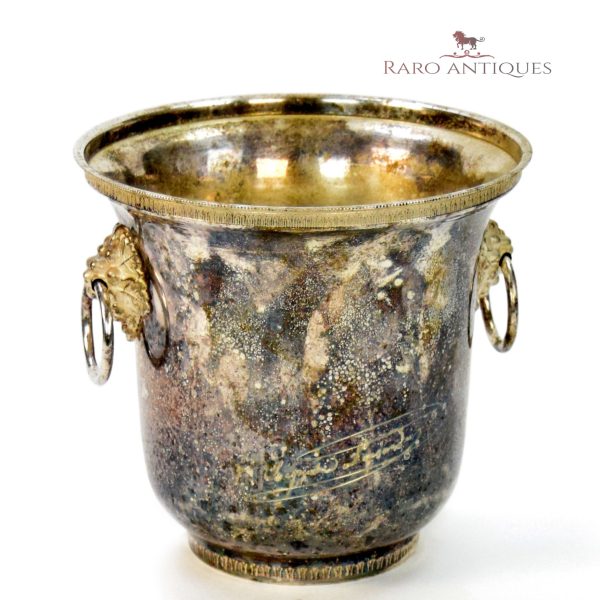
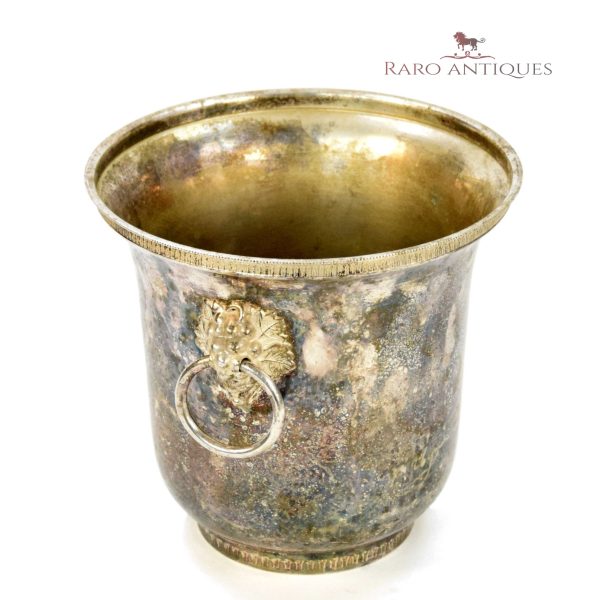
CHAMPAGNE BUCKET VEUVE CLICQUOT PONSARDIN
Champagne bucket for Veuve Clicquot Ponsardin, manufactured by the French company Saint Hilaire Paris in the 1970s.
This silver-plated champagne bucket was produced for the prestigious champagne house Veuve Clicquot Ponsardin, as evidenced by the engraved signature on the bucket itself. Pieces like this were often supplied to luxury hotels, fine restaurants, and wine cellars, where they were used for the elegant presentation and service of this celebrated beverage.
Over the decades, the silver-plated surface has developed a beautiful iridescent patina, which is considered an important part of the character, history, and authenticity of such pieces.
Without a doubt, this is a piece perfectly suited for serving chilled drinks in style. Thanks to its timeless appearance, it also makes an excellent decorative accent for a cocktail corner, kitchen, or home bar.
Dimensions: 21 × 22 × 22 cm
Weight: 1 kg
The bucket is in good condition.

ART DECO TEACUP
Art Deco teacup.
An interesting pair of glass cups with a brass handle and base. Ideal for stylishly serving tea or mulled wine. Certainly, an intriguing set that will captivate anyone. Dimensions: 10.5 x 9.5 cm Weight: 360g The cups are in excellent condition. The glass can be easily removed from the brass handle for washing or potential replacement. Price is for one.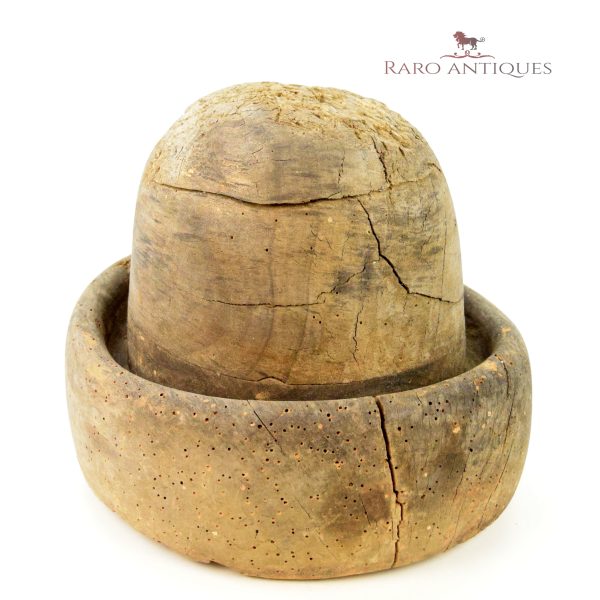

ANTIQUE HAT BLOCK
Hat block, from the early 20th century.
This wooden hat block is a charming decorative piece for anyone interested in vintage fashion. It's perfect for collectors and hat enthusiasts who want to showcase their hats in an original way. Dimensions: 25 x 22 x 20 cm Weight: 2 kg The hat block is in fair condition.
