


Mirrors – faithful companions of our self-image and silent observers of everyday life. From simple polished stone mirrors, where ancient people first caught a wary glimpse of themselves, to today’s glass masterpieces that sometimes reveal more than we’d like. Mirrors have a rich and fascinating history and are not merely practical tools – for centuries, they’ve sparked the imagination, served as magical portals to other worlds, and symbolized the human soul. In this article, we’ll uncover how mirrors traveled the path from ancient tools to objects that both console and critique us.
The first “mirrors” were still ponds, where people, with disbelief, discovered that the reflection they saw was their own. Nature thus provided the first mirror, gifting us water with its reflective properties. This sparked human curiosity, encouraging them to explore and search for ways to create more durable mirrors than simply storing water in buckets and gazing into it.
The first true mirrors were made from materials readily available to people. Volcanic glass, or obsidian, proved to be the most effective, as it could be polished to achieve a reflective surface. However, one clear downside of obsidian was its black color, meaning it was still far from a perfect solution.
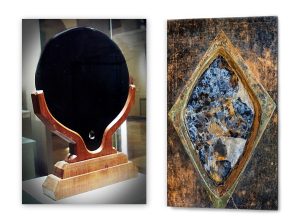
Ancient obsidian mirror.
The black color of obsidian made the reflected image significantly darker, and clear visibility was often difficult. Obsidian mirrors are most commonly found in Turkey and South America, indicating that the concept of mirrors was globally widespread. Particularly in South America, these mirrors were primarily used by shamans for rituals and divination rather than for personal grooming.
Progress from the first polished stone mirrors came with mirrors made of polished copper. These were found among the Mesopotamians and ancient Egyptians. However, these mirrors were still far from the modern ones we know today, functioning similarly to stone mirrors and lacking glass. This meant they shared the same issue as stone mirrors—due to the metal’s color, the reflection remained distorted. Attempts were made to polish other metals, such as gold and silver, but the results were still similar.
The first mirrors resembling modern ones were found in Lebanon and are believed to have been made in the 1st century CE. These were the first mirrors made of glass, coated with gold foil or lead, as these materials were readily available and highly reflective.
The Romans were the ones who eventually discovered how to use blown glass to create reflective surfaces. However, these mirrors resembled concave mirrors more than the flat ones we know today. While concave mirrors slightly distorted reflected images, these glass mirrors were still very popular as they served their purpose, even if they were not particularly efficient.
At this time, mirrors were far from perfect, but people were gradually exploring new production methods. It took several centuries—nearly the entire Middle Ages—for significant advancements to be made. During the Middle Ages, there was a widespread belief that mirrors possessed magical properties, primarily because they reflected and distorted real images. This led to their association with occultism and witchcraft.
Many superstitions arose during this period, with some believing that mirrors could capture the soul or reveal the future. The rarity and high value of mirrors during this time only heightened their mystique. As a result, their use was often treated with great reverence, and in some cases, mirrors were even banned, especially in places where people feared the influence of the supernatural.
It was precisely because of these beliefs that the development of mirrors came to a halt, and significant advancements did not occur until the 16th century, in Venice.
 Venetian mirrors are a pivotal part of the history of mirror development, as they discovered an advanced technique for coating glass with an amalgam of tin and mercury. This innovation allowed for the creation of mirrors with high reflectivity and clarity, a significant improvement compared to previous methods. The mirrors produced in Venice became world-renowned for their exceptional quality and were seen as true status symbols.
One of the most fascinating stories about Venetian mirrors revolves around the protection of their secrets. Venice, which held a near monopoly on mirror production at the time (a source of its immense power and wealth), was determined to maintain this advantage. To safeguard their techniques, master mirror-makers were relocated to the island of Murano. This ensured strict control over the production process and prevented the methods from spreading beyond the city. The artisans were sworn to secrecy, and those who attempted to share their knowledge with outsiders were often sentenced to death. Venetian mirrors thus became symbols of wealth and prestige, remaining mysterious and valuable for a long time due to the secrecy surrounding their production.
This tight control kept mirrors out of broader circulation until the 17th century, when the secrets inevitably began to leak. By then, French and English craftsmen had started developing their own techniques for mirror-making, incorporating more accessible materials like silver and advanced glass-processing methods. This led to the spread of mirror production to other European cities, notably Paris and London, where artisans adapted the technology to create mirrors similar to the Venetian masterpieces.
The disclosure of Venetian mirror-making secrets owes much to the efforts of French King Louis XIV, also known as the Sun King. Louis XIV was eager to acquire this innovative technology to elevate the grandeur of his court at Versailles. Through bribery, he managed to persuade several Venetian craftsmen to reveal the secrets of mirror production to French artisans. These artisans subsequently began producing mirrors for the king, leading to the creation of the famous “Galerie des Glaces” (Hall of Mirrors) in Versailles. When the gallery was completed in the 1680s, it was adorned with an unprecedented number of mirrors—a true marvel of the time and a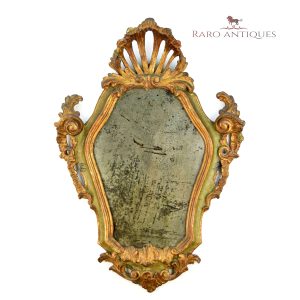 testament to wealth and power.
This event marked a turning point in the history of mirrors. The once-closely-guarded Venetian techniques began spreading across Europe, facilitating further advancements in mirror-making technology. This expansion made mirrors more widely available and affordable, fostering competition in the market.
With increased accessibility, another significant shift occurred in the long history of mirrors. In many European countries, mirrors transitioned from being purely functional items to becoming decorative pieces that symbolized the status and prestige of their owners.
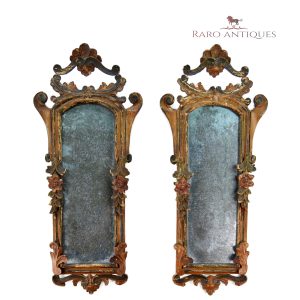 It takes nearly another century for mirrors to advance again. In 1835, mirrors with a silver coating were invented. This technique used a thin layer of metallic silver for reflectivity and is credited to the German chemist Justus von Liebig. His method was quite complex and represented a significant leap forward from previous techniques. The process involved applying a thin layer of metallic silver to clean glass through the chemical reduction of silver nitrate. This innovation revolutionized mirror production, as it required only a small amount of silver while maintaining excellent reflective properties. Liebig’s discovery—that a thick layer of silver was unnecessary for light reflection—enabled faster production and reduced costs. As a result, mirrors became more affordable and accessible to the general population, including those from lower-income groups, due to the simplicity and cost-effectiveness of mass production.
Von Liebig’s invention bears similarities to modern mirror production techniques. However, instead of silver, today’s reflective coatings often use aluminum. In modern manufacturing, molten aluminum is applied to glass using vacuum deposition, a method that allows for even faster and more efficient mirror production than ever before.
We’re confident that mirror-making techniques will continue to evolve. However, as antique enthusiasts, we have a special fondness for mirrors that have already seen centuries, developed a patina, and now display a unique character. Such mirrors seem to possess a soul, making it easy to understand why people in the past, who didn’t encounter mirrors every day, treated them with awe and reverence. Some superstitions about mirrors have even survived to this day. Everyone is familiar with the most famous one: breaking a mirror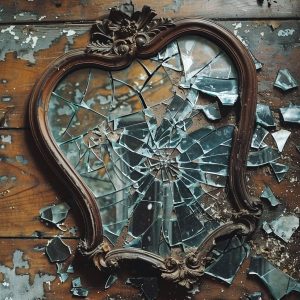 brings seven years of bad luck.
For the curious, we’ll share one last tidbit to close this discussion: how to protect yourself from such misfortune should you ever find yourself in that unlucky situation.
This superstition originates from the time of the Romans, who believed that mirrors did not merely reflect your image but also your soul. Breaking a mirror was thus seen as damage to your soul—a sign that it was no longer connected to you. Since they believed that life renewed itself every seven years, they thought that after seven years, your soul would return to you.
If you break a mirror and want to avoid waiting seven years for bad luck to pass and your soul to be “returned,” you can try one of the methods the Romans used in such situations:
- Under the moonlight, bury all the pieces of the broken mirror.
- Light seven white candles and blow them out at midnight in one breath.
- Leave the broken mirror where it shattered for seven hours before cleaning it up.
Although today we don’t take this belief as seriously, the idea of associating mirrors with the soul is precisely why the superstition about breaking a mirror still exists.
This brings us to the end of our exploration of the long history of mirrors, leaving us at RARO ANTIQUES even more fascinated by this remarkable object. Its history is longer than most imagine, and its cultural significance far more profound than we often realize.
The mirror is undoubtedly an object that will remain with humanity forever. It is our faithful companion, helping us see ourselves as we are. Yet, it’s crucial to recognize that a mirror is more than just a mirror. It is a window into the past, reflecting differences between people today and those of the past, offering us insight into our development, and unveiling legends and superstitions that still accompany us.
How can you remind yourself of this fascinating history in your daily life? With a stunning mirror that carries the patina of time, a piece that has witnessed countless reflections of the past. We invite you to choose your own piece of mirror history, as we at RARO ANTIQUES have a beautiful collection of diverse mirrors. Surely, you’ll find one that’s perfect for you and your home.
Explore our full collection here.