

HARVEY GUZZINI is a company that is well-known in Slovenia, especially through its connection with another legendary company, Meblo. However, despite its recognition, we often know little about its history. Most commonly, the name reminds us of the beautiful ceiling lamps that were incredibly popular in Yugoslav households. While this remarkable collaboration brought about many legendary creations, we will delve into that topic later in this article. First, let us focus on the early years of this iconic company.
It all begins with the elder Guzzini brothers—Giovanni, Raimondo, and Virgilio—who sought their own path to express their entrepreneurial talents outside of Fratelli Guzzini, the company founded by their father. The story comes to life in 1958, when they initially established a craft business named Harvey for the production of enameled copper items.
To this day, it is often mistakenly believed that Harvey Guzzini is either a designer or at least one of the Guzzini brothers, but this is not the case. The inspiration for the company name actually came from the rabbit Harvey, the imaginary friend of the main character in the 1950 film of the same name, portrayed by James Stewart.
The following year, the brothers seized the opportunity to produce acrylic lamps. Guzzini Raimondo established Harvey Creazioni, which expanded to include the production of modern plexiglass chandeliers in collaboration with the young Adolfo Guzzini, who was still a student at the time.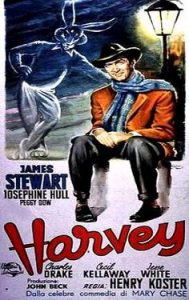

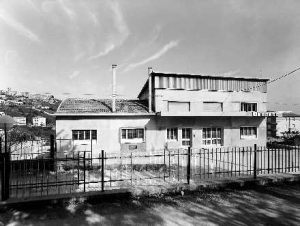
Factory in Le Grazie.
This marked the beginning of the first lamp production, designed by creators such as Karl Roters and Charles Josteen. In 1960, the production moved from the ground floor of Giannunzio Guzzini’s home in Recanati to a new factory in Le Grazie, covering approximately 800 square meters. This transition symbolized the start of true industrial-scale manufacturing for Harvey Guzzini creations.
It was the beginning of gradual growth for what would become the legendary company we all know today. In 1963, Harvey Creazioni Snc di Guzzini R. & C. was officially established. The partners were Giovanni, Raimondo, Virgilio, Giuseppe, Giannunzio, and Adolfo—each an equal stakeholder in the company. From that point onward, the business focused exclusively on lighting production.

The Guzzini brothers with their families and workers.
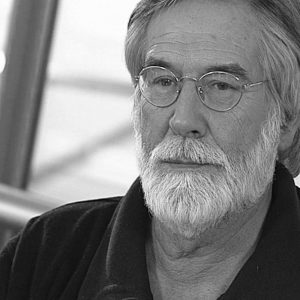
Luigi Massoni
The brothers then hired architect and designer Luigi Massoni, upon the suggestion of Maurizio Adreani, a leading importer of plastics at the time. From that point forward, Massoni took charge of their advertising, significantly boosting the visibility of the company and its creations.
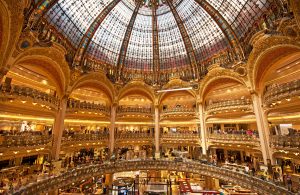
Gallery Lafayette
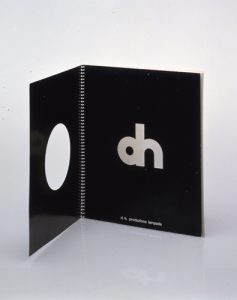 In 1967, the Guzzini brothers showcased their products in Paris at Domus in the Galerie Lafayette under the name Design House (DH). The company presented lamps by several renowned designers, including Gio Ponti. Building on the success of this exhibition, they opened a retail store in central Milan in 1969, named Harvey Guzzini DH, solidifying the brand’s position among the top Italian design houses
In the mid-1970s, Harvey Guzzini ventured into more innovative designs. They developed a range of groundbreaking lamps, including models with revolutionary safety systems and the Ufo series of professional projectors for low-voltage halogen bulbs.
During this period, Harvey Guzzini also began a collaboration with the Nova Gorica-based company Meblo, as they sought to explore furniture design. This partnership led to the creation of lamps that became highly popular in Yugoslav households. These now-iconic designs feature clean, minimalist lines combined with elegant, curved, futuristic shades, often in bold hues like orange and yellow. Today, they remain beloved by collectors and enthusiasts of sophisticated interiors. Renowned for their exceptional quality and modern aesthetic, their simple lines make them adaptable to any style. You can even find a selection of these legendary Harvey Guzzini and Meblo ceiling lamps in our collection.
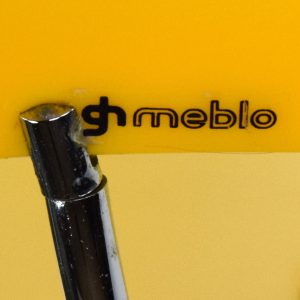
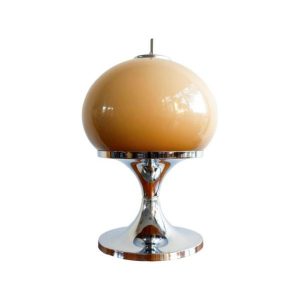
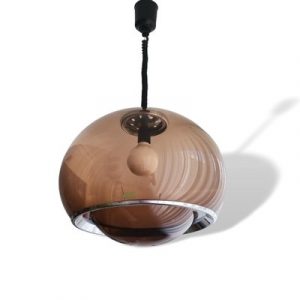
After the highly successful collaboration, Harvey Guzzini was renamed once again in 1981, this time to iGuzzini, the name under which the company still operates today. During this period, they began solidifying their identity with the slogan “Industria Illuminotecnica” (Lighting Industry) and launched the campaign “Illuminare gli italiani” (Lighting up the Italians), which was in use until 1992.

A logo that is still used today.
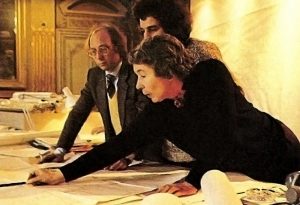
Castiglioni and Aulenti
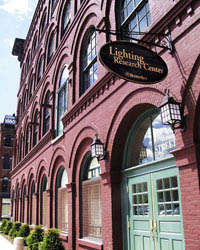
Troy Lighting Research Center, New York
In the 1980s, through a series of educational courses for designers, Harvey Guzzini established itself as a pioneer in promoting a culture of light. In 1988, the company achieved two significant milestones. Designers Gae Aulenti and Piero Castiglioni created the Cestello: the first product featuring multiple bulbs and projectors that could be individually rotated thanks to a system of universal joints. Additionally, the company began its first experiments in the field of biodynamic lighting in collaboration with the Troy Lighting Research Center in New York.
In 1989 and 1991, Harvey Guzzini was honored with the prestigious Compasso d’Oro award. This industrial design award, established in 1954 by La Rinascente, based on an idea by Gio Ponti and Alberto Rosselli, is now considered the most esteemed recognition in its field.
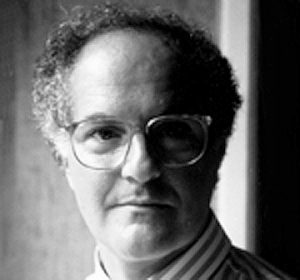
Bruno Gecchelin
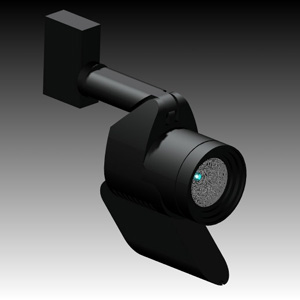
Projector Shuttle
In 1989, Harvey Guzzini received the Compasso d’Oro for the Shuttle, a professional projector for indoor lighting designed by Bruno Gecchelin. In 1991, the company was awarded the prestigious prize for its broad commitment to promoting and developing design. By 1993, the success of their collaboration with the New York research center became evident when iGuzzini presented the experimental prototype SIVRA, the first biodynamic light, at the Science and Technology Museum in Milan.
Guzzini is also a pioneer in another important area. It was the first company to raise awareness about light pollution. In 1994, they launched the campaign “Con iGuzzini contro l’inquinamento luminoso” (With iGuzzini against light pollution), which highlights the importance of energy conservation and preserving the starry sky. The campaign also draws attention to the fact that we are not alone on this planet and that the night is crucial for many nocturnal creatures, whose habitats are threatened by excessive artificial lighting.
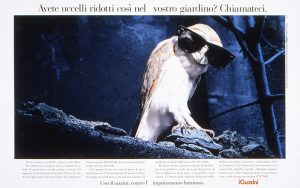
iGuzzini campaign, to combat light pollution.
In 1998, at the Borghese Gallery, they revealed a new method for illuminating important pieces of history, marking the beginning of their program for the promotion and enhancement of cultural heritage, both in Italy and globally. A few years later, this program became known as “Light is Back.”
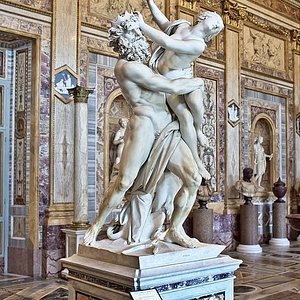
Statues in the Borghese Gallery.
In the same year, they received a new Compasso d’Oro award, this time for the first indirect system of urban lighting, designed by Renzo Piano.
The following year, Harvey Guzzini once again showcased innovation, as designer Jean Michel Wilmotte introduced a completely new method of city illumination—lighting the facades of buildings, a concept that has now become widespread.

Jean Michel Wilmotte
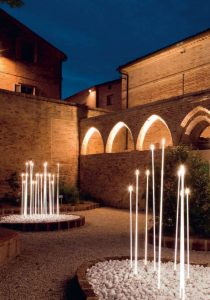
Facade lit in the manner of Jean Michel Wilmott.
They continued their innovation into the new millennium, with one of the most significant achievements in recent years being in 2015. For Leonardo da Vinci’s The Last Supper, they developed an entirely new lighting system using innovative approaches. This system allowed for the fresco to be viewed by a greater number of art enthusiasts.
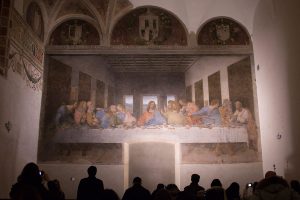
Leonardo da Vinci – The Last Supper
Today, they have expanded their branches to 20 countries and are present on five continents.
Thus, Harvey Guzzini is one of the most important companies of the past century, thanks to their commitment to innovation and outstanding design. We are confident that they will continue to create many legendary lighting pieces, making iGuzzini a brand definitely worth following on their journey.